What Can Be Traded in a Commodities Market
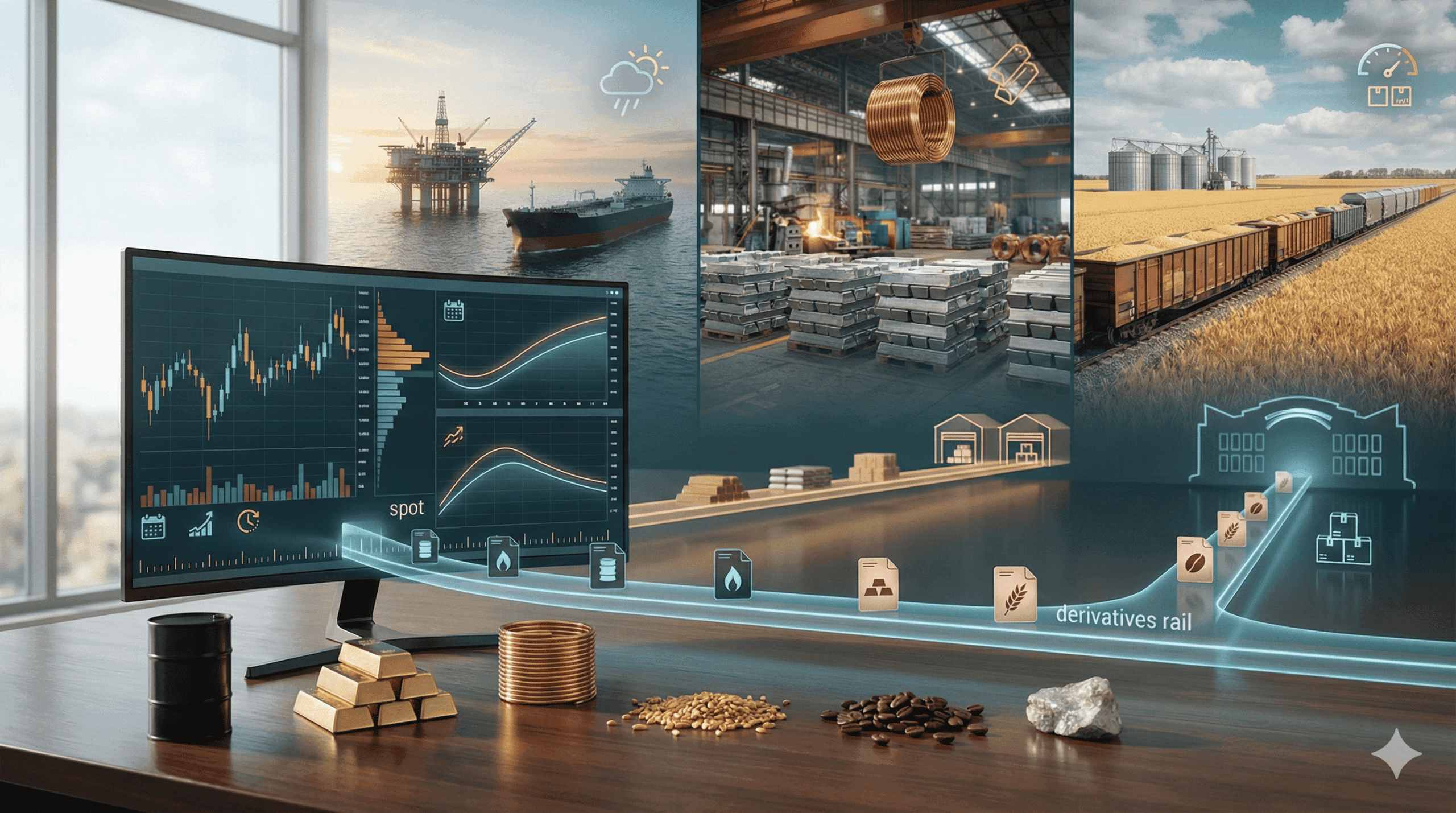
The tickers move, calendars fill up, and it’s easy to forget the simple question: what can be traded in a commodities market? Here’s the calm version with plain-language definitions, concrete examples, and a side-by-side view you can reuse.
“A commodity futures contract is an agreement to buy or sell a particular commodity at a future date; the price and amount are fixed.”
First things first: what is commodity market
A commodity market is where raw or primary goods change hands in spot deals or via derivatives like futures and options. Think energy, metals, and agricultural products.
“The S&P GSCI is one of the most widely recognized commodity benchmarks; broad-based and production-weighted.”
The landscape at a glance: commodity markets by group
A few concrete contract examples
- WTI Crude (NYMEX CL): unit 1,000 barrels; minimum tick 0.01 dollars per barrel equals 10 dollars per tick.
- Brent Crude (ICE B): unit 1,000 barrels; minimum price fluctuation 0.01 dollars per barrel.
- Gold (COMEX GC): contract size 100 troy ounces; tick 0.10 dollars per oz equals 10 dollars per tick.
- Corn (CBOT ZC): contract unit 5,000 bushels; quoted in cents per bushel.
What exactly can you trade (and how)
| Access path | What you actually trade | Why people choose it | Watch-outs |
| Exchange futures | Standardized contracts on energy, metals, gas | Liquidity, central clearing, transparent specs | Margin and daily P/L mean discipline required. |
| Options on futures | Right, not obligation, on a futures contract | Defined risk structures | Greeks and assignment rules add complexity. |
| Spot/forwards (OTC) | Bilateral deals, customized terms | Tailored hedges for commercial users | Counterparty risk and documentation. |
| Index products & ETPs | Baskets tracking commodity indices (e.g., GSCI) | Broad exposure via securities account | Tracking and fees vs underlying futures. |
“Futures contracts are traded on organized exchanges that set standardized terms for the contracts.”
Why conditions change across commodity markets
Global supply, inventories, and policy can reshape price behavior. Recent research highlights how shocks (pandemics, wars, climate) alter energy, metals, and agriculture dynamics for years, not weeks.
Reading the curve without math headaches
Futures may trade above or below spot depending on storage, financing, and inventory (contango vs backwardation). That’s normal. What matters is your carry cost and roll timing, which differ by commodity and season.
Costs and frictions you feel on tickets
- Tick size and tick value (e.g., CL’s $10 per tick; GC’s $10 per tick) drive P/L swings.
- Slippage and spread widen around scheduled reports and thin sessions.
Quick starter map that you can actually use
- Pick one liquid benchmark (WTI, Gold, or Corn).
- Read the exchange spec sheet for size, tick, and hours.
- Put major release times on your calendar (inventories, crop reports).
“Commodity markets are integral to the global economy… understanding what drives these markets is critical.”
FAQ
Is the commodity market only for futures traders
No. Commercials hedge with futures and OTC forwards; investors use index products or producer equities. Futures are just the cleanest price-discovery rail.
Why do WTI and Brent sometimes diverge
Logistics and regional supply differences. Both are 1,000-barrel contracts but different delivery ecosystems and inventories drive spreads.
Do metals markets have different regulations?
Venues implement their own regulations and may modify their positioning or lending policies when stock levels become limited, similar to the actions taken by the LME regarding copper.
Where do I find the exact contract size and tick
Consistently refer to the exchange specifications page for the product, which details units, ticks, trading hours, and relevant codes (such as CL, GC, ZC).
文章
社区
Trading 平台
服务




版权所有 © 2026。保留所有权利。
外汇交易存在亏损风险,并不适合所有人。Tradeview 对任何交易中货币汇率或兑换的盈亏不承担责任。
Tradeview Markets 提供的服务和产品不在美国境内提供,也不向美国法律定义的美国人士提供。本网站上的信息不针对任何当地法律或法规限制或禁止外汇和/或差价合约交易的国家/地区的居民。
差价合约是复杂的金融工具,由于杠杆作用,具有快速亏损资金的高风险。64%的零售投资者在使用Tradeview交易差价合约时亏损。您应考虑是否理解差价合约的运作方式,以及是否能够承担失去资金的高风险。
总部 Tradeview Financial Markets S.A.C: Calle Los Alcanfores No. 495 Int. 505 Urb. Leuro Lima. Lima, Miraflores.
总部 Tradeview Ltd: 13 Genesis Close, 4th Floor, Suite 422, Cayman Islands, KY1-1110
高风险警告: 外汇交易具有很高的风险,可能不适合所有投资者。杠杆作用会增加额外的风险和亏损暴露。在您决定进行外汇交易之前,请仔细考虑您的投资目标、经验水平和风险承受能力。您可能会失去部分或全部初始投资;请勿投资您无法承受的损失。了解与外汇交易相关的风险,并在有任何疑问时寻求独立的金融或税务顾问的建议。
咨询警告: Tradeview提供选定的博客和其他经济及市场信息源的参考和链接,作为对其客户和潜在客户的教育服务,并不认同这些博客或其他信息源的意见或建议。建议客户和潜在客户在分析和决策时,仔细考虑博客或其他信息源所提供的意见和分析。任何博客或信息源都不应被视为业绩记录。过去的表现不保证未来的结果,Tradeview特别建议客户和潜在客户在投资资金或与任何外汇经纪商开立账户之前,仔细审核顾问、博主、资金经理和系统供应商所做的所有声明和表述。本网站内的任何新闻、意见、研究、数据或其他信息均作为市场一般评论提供,并不构成投资或交易建议。Tradeview明确声明,对于因使用或依赖此类信息而直接或间接产生的任何本金或利润损失,概不负责。与所有此类咨询服务一样,过去的表现从不保证未来的结果。