Please note that deposits and withdrawals via Bitwallet are no longer available. Please use alternative methods going forward.
Real-World Difference Between Demo and Live Forex Trading
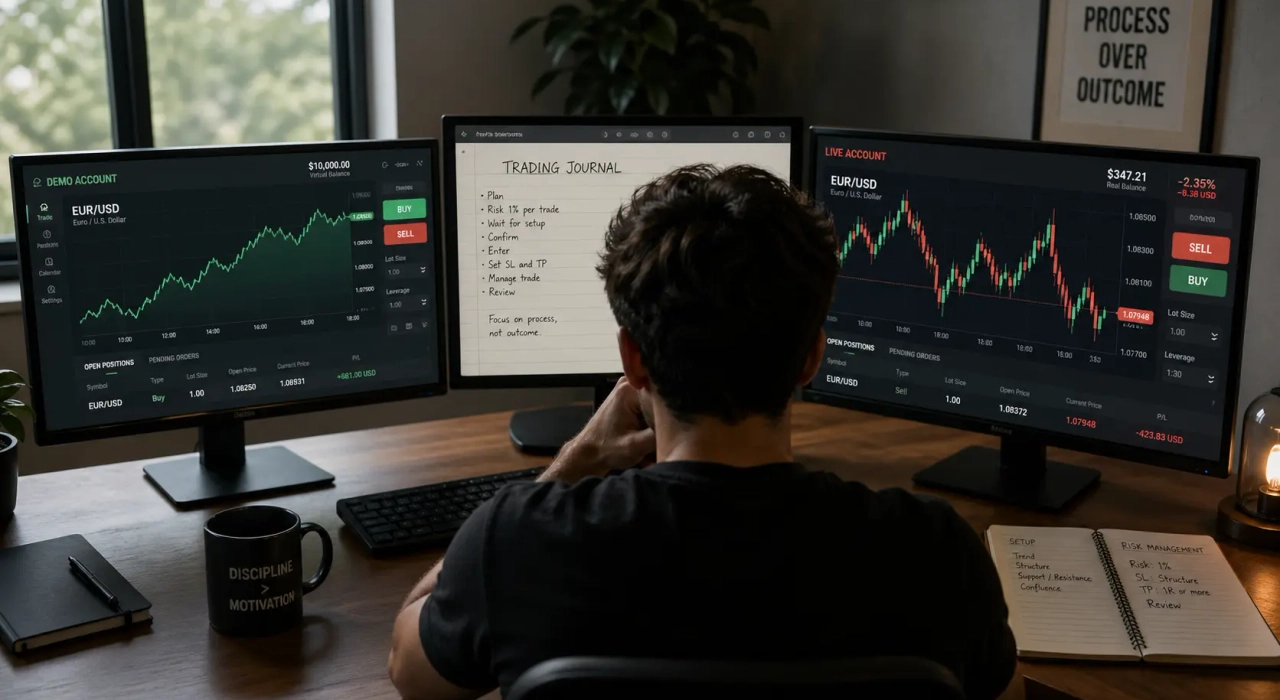
Screens glow, practice trades stack green, then real money enters and everything feels louder. That gap is the difference between demo and live forex trading in one sentence. The market did not change, your rails and reactions did.
“Global FX spot turnover reached about 3 trillion dollars per day in April 2025.”
Forex in plain English
You buy one currency and sell another, always in pairs. EUR USD means euros versus dollars. A pip is the small step most prices move, spreads are the tiny gap between bid and ask, and leverage lets a small deposit control a larger position. That is forex trading explained in simple terms.
“CFDs are complex, high-risk products and the protections for retail investors cap losses and limit leverage.”
What demo changes, and what it cannot
Demo accounts are for learning the forex trading platform and rhythm. Live accounts add slippage, funding charges, and margin discipline. Providers say this plainly.
“Trades made through the demo account will not be subject to slippage or out-of-hours price moves.”
Demo vs live at a glance
| Topic | Demo account feel | Live account reality |
| Pricing and fills | Idealized fills, no slippage in many demos | Slippage possible during news and thin minutes |
| Spreads | Often stable, teaching friendly | Can widen when liquidity thins |
| Margin and close-outs | Rarely enforced the same way | Margin rules can close positions if equity drops |
| Fees and financing | Usually ignored | Overnight financing and adjustments apply |
| Emotions | Detachment, easy to hold losers | Real money changes behavior, tighter decision windows |
| Requotes and rejections | Rare | Possible due to size, price, or venue load |
“New CFD rules ensure you cannot lose more than you put in and restrict leverage, with standard risk warnings.”
The practical edge: measure the gap
Run the same setup in demo and then with the smallest live size your broker allows. Log spread at entry, slippage on exit, and any overnight financing. The notes will teach you faster than opinions.
“Trading in OTC FX markets reached 7.5 trillion dollars per day in April 2022,” a reminder that liquidity is abundant but not uniform every minute.
Stops and targets that travel well
Let’s show how to set stop loss and take profit in forex concrete, using a simple, repeatable structure that behaves in both demo and live.
One-line rules you can keep
- Place the stop beyond the recent structure, not a round number that attracts noise.
- Size the trade so the cash loss at the stop is small and fixed.
- Aim for a first target at least as large as the risk, then reassess.
“A stop-loss triggers at your chosen price to limit downside; trailing and bracket variants exist for different needs.”
Tiny numbers, real clarity
| Pair example | Account risk per trade | Stop distance | Position size idea | First target |
| EUR USD | 15 dollars | 15 pips | 0.10 lot if pip value is 1 dollar | 15 to 25 pips |
| GBP USD | 15 dollars | 20 pips | 0.07 lot if pip value is 1.30 dollars | 20 to 30 pips |
| USD JPY | 15 dollars | 12 pips | 0.12 lot if pip value is 0.90 dollars | 12 to 20 pips |
Small, boring numbers make live nerves manageable. You can always scale after your logs look steady.
Bridging demo habits into live conditions
- Keep the same entry logic, but tighten pre-trade checks for calendar events.
- If spreads expand near news, skip the first minute rather than forcing a fill.
- Review margin and negative balance rules so surprises are rare if volatility jumps.
“Retail CFD protections include leverage limits, margin close-out at 50 percent of initial margin, and negative balance protection.”
Bringing it together
Practice builds muscle, money reveals reflexes. Treat the demo as choreography practice, then move to live with micro size so you can observe slippage, financing, and your own reactions without damage. If this clicked, write a one-page plan that defines your maximum cash loss per trade, your stop location logic, and your first target rule, then trade that plan for two weeks so your notes capture the true difference between demo and live forex trading. Keep the venue where reports make forex trading explained in simple terms feel honest and where how to set stop loss and take profit in forex stays easy to execute.
FAQ
Are demo prices identical to live prices
They can be sourced from the same stream, yet demos often omit slippage and some adjustments. Live trades can face size limits, rejections, and spread changes during thin periods.
Do regulators view demo and live risk differently
Rules focus on live accounts. In many regions, CFDs for retail users include leverage caps, margin close-out thresholds, and negative balance protection.
Why do my live stops slip on major news
Because quotes can gap and depth things. That creates execution at the next available price rather than the exact stop level. This is normal market behavior, not a platform bug.
Should I switch to live only after perfect demo results
No. Move to the smallest live size once you can follow your plan mechanically. The emotional layer only appears with real money, and you need data from that context.
How big should my first stop be
Big enough to sit beyond the nearby structure, small enough that the cash loss is trivial. The table above shows a simple way to align dollars, pips, and size.
Community
Trading platforms
Services
Articles
Community
Trading platforms
Services




Copyright © 2026. All rights reserved.
There is a risk of loss in trading foreign currencies and it is not suitable for everyone. Tradeview is not responsible for any gains or losses on currency rates or exchanges during any transaction.
The services and products offered by Tradeview are not being offered within the United States (US) and not being offered to US Persons, as defined under US law. The information on this website is not directed to residents of any country where FX and/or CFDs trading is restricted or prohibited by local laws or regulations.
CFDs are complex instruments and come with a high risk of losing money rapidly due to leverage. 64% of retail investors' accounts lose money when trading CFDs with Tradeview. You should consider whether you understand how CFDs work and whether you can afford to take the high risk of losing your money.
Headquarters Tradeview Ltd.: 13 Genesis Close, 4th Floor, Suite 422, Cayman Islands
High Risk Warning: Foreign exchange trading carries a high level of risk that may not be suitable for all investors. Leverage creates additional risk and loss exposure. Before you decide to trade foreign exchange, carefully consider your investment objectives, experience level, and risk tolerance. You could lose some or all your initial investment; do not invest money that you cannot afford to lose. Educate yourself on the risks associated with foreign exchange trading and seek advice from an independent financial or tax advisor if you have any questions.
Advisory Warning: Tradeview provides references and links to selected blogs and other sources of economic and market information as an educational service to its clients and prospects and does not endorse the opinions or recommendations of the blogs or other sources of information. Clients and prospects are advised to carefully consider the opinions and analysis offered in the blogs or other information sources in the context of the client or prospect's individual analysis and decision making. None of the blogs or other sources of information is to be considered as constituting a track record. Past performance is no guarantee of future results and Tradeview specifically advises clients and prospects to carefully review all claims and representations made by advisors, bloggers, money managers and system vendors before investing any funds or opening an account with any Forex dealer. Any news, opinions, research, data, or other information contained within this website is provided as general market commentary and does not constitute investment or trading advice. Tradeview expressly disclaims any liability for any lost principal or profits without limitation which may arise directly or indirectly from the use of or reliance on such information. As with all such advisory services, past results are never a guarantee of future results.