Please note that deposits and withdrawals via Bitwallet are no longer available. Please use alternative methods going forward.
Trading Platform Selection That Fits Real Trading Habits
Picking a trading platform can feel like buying a car in the rain: everything looks shiny, everyone claims performance, and the details that matter show up only after you’ve signed up. The simplest way to avoid regret is to treat trading platform selection as a fit problem, not a popularity contest.
A platform is “good” only in context. A day trader needs different tools than a swing trader. A multi-asset investor cares about different costs than a single-market specialist. And if you trade actively, execution quality and access to diverse liquidity providers can matter more than extra indicators. None of this requires hype. It just requires clarity.
“The best platform is the one that makes your good habits easier and your bad habits harder.”
This guide gives you a practical way to evaluate platforms, starting with the part most people skip: understand your trading strategy before you compare features.
Start by defining your trading behavior
Most platform comparisons start with tools. Better is to start with behavior: the actions you repeat every week.
Answer these in plain language:
- How often do you trade: monthly, weekly, daily?
- Do you hold positions overnight?
- Are you sensitive to spreads and slippage, or do you trade infrequently enough that it’s minor?
- Do you use limit orders, or mostly market orders?
- Do you need automation, alerts, or journaling exports?
If you cannot answer these, you are likely to pick a platform that looks impressive and feels annoying in practice.
Understand your trading strategy before you compare platforms
It is hard to choose a platform without knowing how you trade. You do not need a complex “system,” but you do need a structure.
To understand your trading strategy, define:
- Your main setup type (trend, breakout, mean reversion, event-driven)
- Your timeframe (intraday, swing, position)
- Your risk approach (fixed risk per trade, max daily loss, portfolio heat)
- Your market focus (FX, equities, indices, commodities, crypto where allowed)
Why this matters: platform requirements change with strategy. The same feature can be crucial for one strategy and irrelevant for another.
Strategy-to-platform fit examples
| Strategy style | Platform priorities | Nice-to-have | Common mismatch |
| Day trading | fast execution, hotkeys, stable charts | DOM/ladder tools | platform with slow routing |
| Swing trading | clean charting, alerts, easy order edits | research feed | platform lacking good alerts |
| Automation | backtesting, robust logs, VPS support | strategy marketplace | weak data and poor monitoring |
| Multi-asset | unified reporting, product breadth | portfolio views | inconsistent fees per asset |
This is why “best platform” lists are often useless. The fit depends on the way you trade.
“Strategy first. Platform second. Everything else is noise.”
The execution layer: where platforms truly differ
Most platforms can draw charts. Fewer handle execution cleanly when markets get fast. Execution quality shows up as:
- Stable spreads during your trading hours
- Predictable order fills
- Low reject rates
- Minimal “mystery” slippage spikes
Metrics to ask about or monitor yourself
If you can’t get official stats, you can still track your own fills.
| Execution signal | What it tells you | How to test |
| Slippage tails (p95) | worst fills, not average | log fills vs expected price |
| Reject rates | routing/risk friction | track reject reason codes |
| Spread percentiles | liquidity stress | watch spreads by session |
| Latency spikes | platform under load | note delays during news |
If you are an active trader, this section matters more than the number of indicators included.
Diverse liquidity providers: what that phrase really affects
Platforms and brokers sometimes mention diverse liquidity providers to suggest better pricing and depth. The practical impact depends on how routing and aggregation are handled.
In plain terms, multiple liquidity sources can help:
- Reduce the chance of one provider degrading your pricing
- Improve depth for larger orders
- Create redundancy during volatile periods
But it is not automatic. More providers does not guarantee better fills if:
- Routing logic is weak
- Last-look behavior is opaque
- Quotes are “best price” but not reliably executable
Practical questions to ask
- Is pricing aggregated, and how is the “best” quote chosen?
- Are there safeguards for quote staleness?
- How are rejects categorized (liquidity vs platform vs risk)?
- Do spreads widen materially during your session, and is it consistent?
You are trying to understand whether “diverse providers” leads to stability, not just marketing vocabulary.
“Depth and redundancy matter only if routing is disciplined.”
Costs: where “cheap” can become expensive
Costs are not only commissions. Depending on your market and broker model, costs may include:
- Spreads
- Swaps/financing (overnight holds)
- Platform subscription tiers
- Market data fees
- Currency conversion fees
- Withdrawal and transfer fees
A practical cost checklist
| Cost item | Who charges it | When it matters most |
| Spreads | broker/venue | high-frequency and short-term trading |
| Commissions | broker | equity/options and some FX models |
| Financing/swaps | broker | swing/position trading |
| Data fees | platform | active equity/level 2 users |
| Withdrawal fees | broker | frequent cash movement |
| FX conversion | broker/bank | trading international assets |
For day traders, spreads and execution dominate, and swing traders, financing and stability matter more. For investors, data fees and reporting quality can be the deciding factor.
Platform tools that actually change outcomes
Some platform features are nice; a few change behavior and reduce mistakes.
Tools that improve discipline
- Bracket orders (entry + stop + target)
- One-click position sizing based on stop distance
- Alerts tied to levels, not noise
- Journaling exports with timestamps and fills
To improve workflow
- Watchlists that sync across devices
- Templates that reduce daily setup time
- Stable mobile execution if you manage on the go
Tools that can cause problems
- Excessive social feeds that trigger impulse trades
- “Hot market” lists that encourage chasing
- Too many indicators that slow decision-making
A platform can be powerful and still be bad for your psychology. That counts.
Reliability and support: the unsexy part that matters
The first time you need help is when you learn whether the platform is truly usable.
A quick reliability checklist:
- Uptime history or incident communication
- Clarity of order confirmations and account statements
- Support response times during busy market hours
- Documentation quality for order types and fee
A simple test many traders skip:
- Open an account
- Fund a small amount
- Place a limit order and a market order
- Download a statement
- Test a withdrawal
- Contact support with one clear question
If support is slow in calm conditions, it will be worse when volatility hits.
“The real platform review begins at the first withdrawal and the first support ticket.”
Common selection mistakes that create regret
Choosing based on influencer preference
Fit beats popularity. A platform that suits someone else’s style can be wrong for your risk tolerance or schedule.
Confusing features with usability
A platform can have every tool and still be clumsy. Usability is about doing your repeated actions quickly and correctly.
Ignoring liquidity and execution
If you trade actively, execution problems will cost more than a premium subscription ever would.
No written strategy
If you don’t understand your trading strategy, you will chase platforms the same way you chase trades.
If you want trading platform selection to feel simple, start by writing a one-page summary so you understand your trading strategy in practical terms: timeframe, setup type, risk limits, and the markets you actually trade. Then test platforms for two weeks with real workflows: order types you use, alerts you rely on, and a small withdrawal test. Finally, ask execution-focused questions about routing and diverse liquidity providers so you’re evaluating stability and fill quality, not just a feature list; if you tell me your timeframe (day vs swing), your top instruments, and whether you need automation, I can propose a tailored platform scorecard and a two-week test script you can run consistently.
FAQ
What is the first step in trading platform selection?
Define your trading behavior and strategy needs first. Without that, you will compare features that may not matter to your results.
Why does it matter to understand your trading strategy before picking a platform?
Because platform requirements change by strategy. Day traders need fast execution and hotkeys, while swing traders prioritize alerts, overnight cost clarity, and stability.
Do diverse liquidity providers guarantee better spreads and fills?
No. They can improve redundancy and depth, but only if routing, aggregation, and quote integrity safeguards are solid. Monitoring spreads and rejects by session is still important.
Which platform features help most with discipline?
Bracket orders, risk-based position sizing tools, clear order confirmations, and reliable alerts. These reduce common execution mistakes.
How long should I test a platform before committing?
A structured two-week trial is a practical minimum. It reveals session behavior, usability friction, and support responsiveness.
What is a simple way to compare platforms fairly?
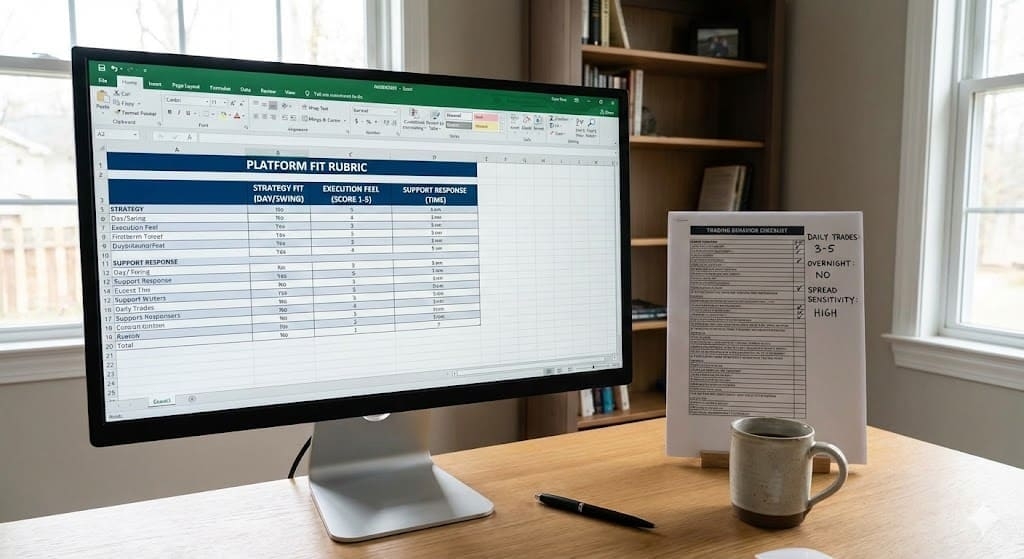
Use a rubric: strategy fit, execution feel, cost transparency, tools/UX, reliability, and support. Score each 1 to 5 after running the same test workflow.
Community
Trading platforms
Services
Articles
Community
Trading platforms
Services




Copyright © 2026. All rights reserved.
There is a risk of loss in trading foreign currencies and it is not suitable for everyone. Tradeview is not responsible for any gains or losses on currency rates or exchanges during any transaction.
The services and products offered by Tradeview are not being offered within the United States (US) and not being offered to US Persons, as defined under US law. The information on this website is not directed to residents of any country where FX and/or CFDs trading is restricted or prohibited by local laws or regulations.
CFDs are complex instruments and come with a high risk of losing money rapidly due to leverage. 64% of retail investors' accounts lose money when trading CFDs with Tradeview. You should consider whether you understand how CFDs work and whether you can afford to take the high risk of losing your money.
Headquarters Tradeview Ltd.: 13 Genesis Close, 4th Floor, Suite 422, Cayman Islands
High Risk Warning: Foreign exchange trading carries a high level of risk that may not be suitable for all investors. Leverage creates additional risk and loss exposure. Before you decide to trade foreign exchange, carefully consider your investment objectives, experience level, and risk tolerance. You could lose some or all your initial investment; do not invest money that you cannot afford to lose. Educate yourself on the risks associated with foreign exchange trading and seek advice from an independent financial or tax advisor if you have any questions.
Advisory Warning: Tradeview provides references and links to selected blogs and other sources of economic and market information as an educational service to its clients and prospects and does not endorse the opinions or recommendations of the blogs or other sources of information. Clients and prospects are advised to carefully consider the opinions and analysis offered in the blogs or other information sources in the context of the client or prospect's individual analysis and decision making. None of the blogs or other sources of information is to be considered as constituting a track record. Past performance is no guarantee of future results and Tradeview specifically advises clients and prospects to carefully review all claims and representations made by advisors, bloggers, money managers and system vendors before investing any funds or opening an account with any Forex dealer. Any news, opinions, research, data, or other information contained within this website is provided as general market commentary and does not constitute investment or trading advice. Tradeview expressly disclaims any liability for any lost principal or profits without limitation which may arise directly or indirectly from the use of or reliance on such information. As with all such advisory services, past results are never a guarantee of future results.