Please note that deposits and withdrawals via Bitwallet are no longer available. Please use alternative methods going forward.
Trade Global Indices Like DAX and NASDAQ Online
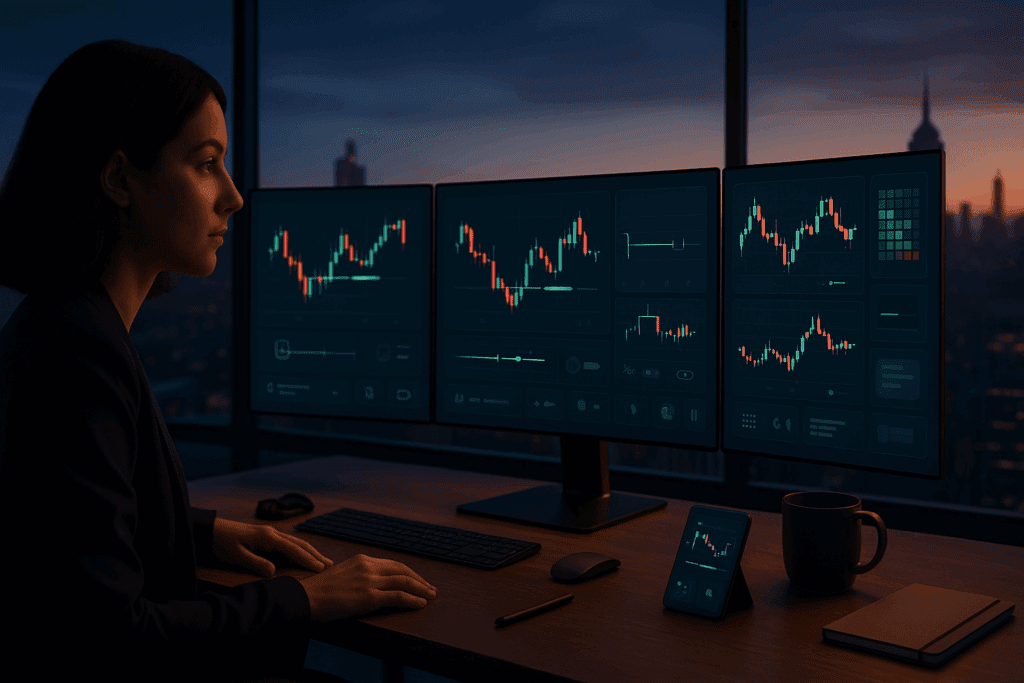
You want to trade global indices like DAX and NASDAQ online without noise. That means one clean ticket, risk shown in cash before you click, and reports that match exports line by line.
This guide gives you a practical checklist, intraday trading strategies for S&P 500 CFDs, and a clear path for how to trade US and EU indices in one account.
Quick take
- One login, one order ticket, one cash risk number per trade
- Brackets attach by default so exits stay honest
- Choose a short, liquid menu that fits your hours
- Track spread, slippage, and export parity for twenty sessions
Choose tools you can audit, not just admire.
What a good index platform looks like
| Area | Must have | Why it matters |
| Order ticket | Cash risk preview, OCO brackets, market if touched | Prevents accidental oversizing and late exits |
| Product list | S&P 500, Nasdaq 100, DAX, at least one UK or EU index | Matches your session’s liquidity |
| Symbol specs | Tick value, min step, session hours, funding in cash | Fast, error free sizing |
| Routing quality | Session aware venues with price collars | Cleaner fills at opens and around prints |
| Risk tools | Per day loss cap, max size per symbol, session filters | Small mistakes stay small |
| Reporting | Statements equal CSV or API exports | Disputes end in minutes |
| Mobile parity | Same ticket logic on phone and desktop | No second learning curve |
If a demo cannot prove these in ten minutes, life will not be kinder.
Liquidity windows that actually help
| Index | Strongest window by local time | Notes |
| S&P 500 | US open and last hour | Clean structure, reacts to macro prints |
| Nasdaq 100 | US tech window | Faster flow, respect hot minutes |
| DAX 40 | First hour of Europe plus EU to US overlap | Punchy opens and clear catalysts |
| FTSE 100 | UK session | Range friendly with steady rhythm |
Start with one US index and one EU index that match your day. Add a third only after two calm weeks.
Sizing index trades in plain cash
Let the platform do the arithmetic. You decide dollars.
- Risk per trade: 45 dollars
- Planned stop: 9 points
- Dollar per point on your contract: 1
- Contracts = 45 ÷ 9 = 5
“Cash language travels across assets. Keep it.”
Intraday trading strategies for S&P 500 CFDs
Keep the playbook short so you can repeat it.
1) Opening range break and retest
- Box the first minutes of the session
- Wait for a clear break
- Enter on the first clean retest to the box edge with brackets o
- Skip if the retest fails to pause
Why it works
The open sets tone and liquidity. The retest avoids chasing the first spike.
2) Pullback into value
- Confirm direction on a higher timeframe
- Mark a value band such as VWAP
- Take the first measured pullback that pauses
- Place the stop beyond the band and let the bracket work
Why it works
You trade with the session’s pressure instead of fighting it.
3) First hour range fade on quiet days
- If range forms and news is light
- Fade edges with small size and tight stop
- Exit at mid or opposite edge using bracket targets
Why it works
The first hour often balances before a later push. You take the small, clean bites.
Rules that protect you
- Two attempts per idea, then stand down
- Size down around scheduled prints
- Trade retests, not first bursts, on volatile days
How to trade US and EU indices in one account
You do not need three logins. You need a broker that gives you the same risk language across regions.
What to insist on
- One KYC and wallet for both regions
- Identical ticket behavior for S&P 500, Nasdaq 100, DAX, and FTSE
- Symbol specs in cash for each index
- Session filters so you can block thin hours or blackout near big prints
- Exports that equal statement totals without edits
Daily rhythm you can keep
- EU morning: DAX setup only, two attempts max
- Midday reset: log results, no revenge trades
- US window: S&P 500 or Nasdaq 100 setup, two attempts max
- Close: export fills and match totals to your statement
Depth beats quantity. Two sessions, one setup per session, tiny risk at first.
Costs decide more than headlines
Track real numbers for twenty sessions so your comparison is honest.
| Cost line | Where to check | Practical move |
| Spread and commission | Ticket preview and actual fills | Trade core minutes, avoid chasing |
| Slippage | Fill minus expected price at entries and exits | Prefer retests over first spikes |
| Funding or swaps | If you hold past the close | Match hold time to cost or day trade early on |
| Data or platform fees | Only pay for what you use | Keep tools that change outcomes |
| Payments | Deposit and withdrawal timelines and fees | Write steps in your notes to avoid surprises |
“Cost clarity turns uncertainty into a choice you can live with.”
Platform checklist to copy into your trial
Must haves
- Cash risk shown on ticket before submit
- Bracket presets saved as default
- Session filters and optional news blackout timer
- Symbol specs in cash terms for US and EU indices
- CSV or API exports that equal your statements
Nice to haves
- One click screenshot for journaling
- Price and time alerts in your time zone
- Workspaces that switch layouts between EU and US
Two week plan that exposes the truth
Week 1
- Trade DAX during your EU morning only
- Risk 20 to 50 dollars per idea
- Log spread, slippage, and time to fill per trade
- Export and reconcile totals daily
Week 2
- Add S&P 500 in your US window
- Keep size small and respect prints
- Compare all in costs and behavior between the two
- Keep the index that makes your journal calm and your reporting exact
Safety habits that protect the month
- Per day loss cap that pauses new orders until server reset
- Max open positions per symbol to limit concentration
- Two attempts per idea, then walk away
- Session filters to skip thin hours and hot minutes
- Plain messages when rules fire
FAQ
Can I learn two indices at once
Yes, if they are in different sessions. Start with DAX for EU hours and S&P 500 for US hours. One setup each, small size.
Is Nasdaq 100 too fast for beginners
It is faster than S&P 500. Begin with S&P 500 CFDs, then test Nasdaq 100 once your logs show calm execution and clean costs.
Do I need multiple accounts for US and EU indices
No. A solid multi region broker lets you trade both with one login and the same risk language. Confirm export parity and session filters before you fund.
Which strategy should I start with
Opening range break and retest. It forces patience and uses the bracket to shape exits. Add pullback into value once you are consistent.
How long should I stay on demo
Seven to ten sessions in your real hours reveal spreads, slippage, and export quality. Switch to a tiny live size only after your checklist passes.
A gentle nudge before you commit
Write a one page plan with your sessions, fixed cash risk, the single setup you will practice, and the three numbers you will track for twenty sessions: spread, slippage, export parity. Then pick the platform that lets you trade global indices like DAX and NASDAQ online while applying your intraday trading strategies for S&P 500 CFDs and keeping US and EU indices in one account without surprises.
Community
Trading platforms
Services
Articles
Community
Trading platforms
Services




Copyright © 2026. All rights reserved.
There is a risk of loss in trading foreign currencies and it is not suitable for everyone. Tradeview is not responsible for any gains or losses on currency rates or exchanges during any transaction.
The services and products offered by Tradeview are not being offered within the United States (US) and not being offered to US Persons, as defined under US law. The information on this website is not directed to residents of any country where FX and/or CFDs trading is restricted or prohibited by local laws or regulations.
CFDs are complex instruments and come with a high risk of losing money rapidly due to leverage. 64% of retail investors' accounts lose money when trading CFDs with Tradeview. You should consider whether you understand how CFDs work and whether you can afford to take the high risk of losing your money.
Headquarters Tradeview Ltd.: 13 Genesis Close, 4th Floor, Suite 422, Cayman Islands
High Risk Warning: Foreign exchange trading carries a high level of risk that may not be suitable for all investors. Leverage creates additional risk and loss exposure. Before you decide to trade foreign exchange, carefully consider your investment objectives, experience level, and risk tolerance. You could lose some or all your initial investment; do not invest money that you cannot afford to lose. Educate yourself on the risks associated with foreign exchange trading and seek advice from an independent financial or tax advisor if you have any questions.
Advisory Warning: Tradeview provides references and links to selected blogs and other sources of economic and market information as an educational service to its clients and prospects and does not endorse the opinions or recommendations of the blogs or other sources of information. Clients and prospects are advised to carefully consider the opinions and analysis offered in the blogs or other information sources in the context of the client or prospect's individual analysis and decision making. None of the blogs or other sources of information is to be considered as constituting a track record. Past performance is no guarantee of future results and Tradeview specifically advises clients and prospects to carefully review all claims and representations made by advisors, bloggers, money managers and system vendors before investing any funds or opening an account with any Forex dealer. Any news, opinions, research, data, or other information contained within this website is provided as general market commentary and does not constitute investment or trading advice. Tradeview expressly disclaims any liability for any lost principal or profits without limitation which may arise directly or indirectly from the use of or reliance on such information. As with all such advisory services, past results are never a guarantee of future results.