Please note that deposits and withdrawals via Bitwallet are no longer available. Please use alternative methods going forward.
The 24-Hour Cycle: Optimizing Your Schedule for Currency Profit
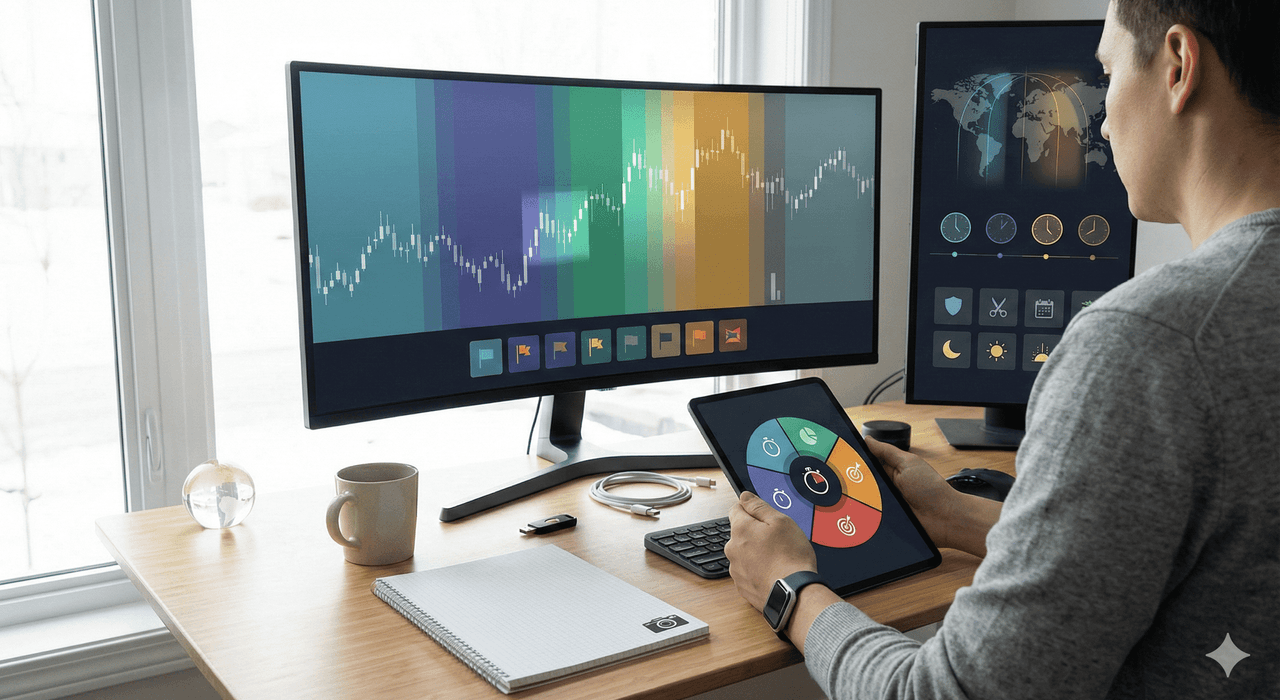
In the stock market, the opening bell rings at 9:30 AM in New York, and the closing bell rings at 4:00 PM. It is a rigid, predefined workday. If you want to trade outside of those hours, you are largely out of luck.
The foreign exchange world is different. There is no central exchange, no single building where all the trades happen, and no single person to ring a bell. Instead, the market is a global relay race of banks, hedge funds, and retail speculators passing the baton from one financial hub to the next. For someone looking into day trading currency market opportunities, this freedom is both a blessing and a curse.
The blessing is that you can trade whenever you want. The curse is that if you trade at the wrong time, you might be staring at a chart that doesn’t move for four hours. Liquidity, the lifeblood of a day trader, is not distributed equally across the 24-hour cycle. To succeed, you don’t just need to know what to buy; you need to know when the smart money is at its desk.
The Four Major Sessions
While the market is technically open 24/5, it is broken down into four distinct sessions based on the business hours of major financial capitals. Understanding these forex market trading times is the first step in building a strategy.
All times below are approximate and can shift slightly due to Daylight Savings Time changes in different countries.
1. The Sydney Session (Pacific)
- Approximate Time (UTC): 10:00 PM – 7:00 AM
- Characteristics: This is where the trading day officially begins. It is usually the quietest of the major sessions. Volatility is generally low, and price movements can be “rangy” or sideways.
- Key Pairs: AUD/USD, NZD/USD.
2. The Tokyo Session (Asian)
- Approximate Time (UTC): 12:00 AM – 9:00 AM
- Characteristics: Japan is the third-largest forex trading center in the world. During this time, the Yen sees the most action. It is often a period of consolidation where the market digests news from the US close.
- Key Pairs: USD/JPY, GBP/JPY, AUD/JPY.
3. The London Session (European)
- Approximate Time (UTC): 8:00 AM – 5:00 PM
- Characteristics: This is the heavyweight champion. London is the central hub of global forex transactions, accounting for roughly 43% of total global volume. Trends often originate here. If you are looking for big moves, this is when they start.
- Key Pairs: EUR/USD, GBP/USD, EUR/GBP, USD/CHF.
4. The New York Session (North American)
- Approximate Time (UTC): 1:00 PM – 10:00 PM
- Characteristics: The second most liquid session. The US Dollar is involved in 85% of all trades, so when US banks open, volume spikes. This session is heavily influenced by US economic data releases (like Non-Farm Payrolls).
- Key Pairs: All major pairs involving the USD.
The Magic of the Overlap
If you are a day trader, you are hunting for volatility. You need price movement to make a profit. The absolute best time to find this is during the “overlaps”, periods when two major financial centers are open simultaneously.
The London / New York Overlap
- Time (UTC): 1:00 PM – 5:00 PM
- Why it matters: This is the busiest time of the day. You have the London bankers coming back from lunch and the New York brokers just arriving with their morning coffee. The massive liquidity often results in tighter spreads and explosive trends.
The Tokyo / London Overlap
- Time (UTC): 8:00 AM – 9:00 AM
- Why it matters: This is a brief window where Asian markets are closing and European markets are opening. It can see sharp moves as Asian traders exit positions and European traders enter them.
Matching Your Personality to the Clock
Not every trader is built for the chaos of the London/New York overlap. Your choice of what are market trading hours you participate in should match your risk tolerance.
- The Aggressive Scalper: You want the overlap (1:00 PM – 5:00 PM UTC). You need fast-moving candles and plenty of liquidity to get in and out quickly.
- The Range Trader: You might prefer the Asian session. If the market is bouncing predictably between two price levels without breaking out, a range strategy works best. The lower volatility of the Tokyo session supports this.
- The Swing Trader: You generally enter during the London open to catch the formation of the “daily candle” direction and hold it through the US session.
The “Dead Zones”
Just as important as knowing when to trade is knowing when not to trade.
There is a period often referred to as the “twilight zone” between the New York close (10:00 PM UTC) and the Sydney open. During this time, liquidity dries up. Spreads (the cost to trade) can widen significantly because there are fewer buyers and sellers.
Trading during these thin hours is risky. A relatively small order can move the market disproportionately, leading to “whipsaw” price action that hits your stop loss for no fundamental reason.
Weekend Gaps
The forex market closes on Friday afternoon (New York time) and reopens Sunday evening (Sydney time). While the retail market is closed, the world keeps turning.
Geopolitical events, elections, or economic disasters can happen over the weekend. When the market reopens on Sunday, the price might “gap” significantly from where it closed on Friday.
“A gap is a price jump where no trading occurred. If you are holding a position over the weekend, a gap can bypass your stop loss, leading to a loss larger than you planned.”
Most experienced day traders close all positions on Friday afternoon to avoid this risk. They prefer to sleep soundly and start fresh on Monday.
Frequently Asked Questions
1. Can I day trade forex on weekends?
Generally, no. The retail forex market is closed from Friday afternoon (approx. 5:00 PM EST) to Sunday afternoon (approx. 5:00 PM EST). While some cryptocurrency markets are open 24/7, standard currency pairs like EUR/USD are not tradable on weekends.
2. Which is the best currency pair to trade for beginners?
The EUR/USD is the most popular choice. It has the highest volume, which usually means it has the lowest spread (cost) and most stable price action. It is less prone to the erratic spikes seen in “exotic” pairs like the USD/MXN.
3. Do I need to wake up in the middle of the night to trade?
Not necessarily. It depends on your time zone and strategy. If you live in New York and want to trade the London Open (3:00 AM EST), yes. However, you can successfully trade the New York Open (8:00 AM EST) during normal morning hours.
4. What happens if I leave a day trade open overnight?
You will be charged or paid a “swap” fee (rollover). This is the interest rate difference between the two currencies you are trading. If you are a strict day trader, you should close positions before the daily rollover time (usually 5:00 PM New York time) to avoid these calculations.
5. Why are spreads higher during the Asian session?
Liquidity is lower during the Asian session compared to London or New York, specifically for non-Yen pairs (like EUR/GBP). Lower liquidity means brokers take on more risk to match your trade, so they widen the spread to compensate.
6. Is the market open on holidays?
The forex market is decentralized, so it technically stays open even if it is a holiday in the US (like Thanksgiving). However, volume will be extremely low, and trading conditions will be poor. It is usually best to avoid trading when a major financial center (London or New York) is on holiday.
Community
Trading platforms
Services
Articles
Community
Trading platforms
Services




Copyright © 2026. All rights reserved.
There is a risk of loss in trading foreign currencies and it is not suitable for everyone. Tradeview is not responsible for any gains or losses on currency rates or exchanges during any transaction.
The services and products offered by Tradeview are not being offered within the United States (US) and not being offered to US Persons, as defined under US law. The information on this website is not directed to residents of any country where FX and/or CFDs trading is restricted or prohibited by local laws or regulations.
CFDs are complex instruments and come with a high risk of losing money rapidly due to leverage. 64% of retail investors' accounts lose money when trading CFDs with Tradeview. You should consider whether you understand how CFDs work and whether you can afford to take the high risk of losing your money.
Headquarters Tradeview Ltd.: 13 Genesis Close, 4th Floor, Suite 422, Cayman Islands
High Risk Warning: Foreign exchange trading carries a high level of risk that may not be suitable for all investors. Leverage creates additional risk and loss exposure. Before you decide to trade foreign exchange, carefully consider your investment objectives, experience level, and risk tolerance. You could lose some or all your initial investment; do not invest money that you cannot afford to lose. Educate yourself on the risks associated with foreign exchange trading and seek advice from an independent financial or tax advisor if you have any questions.
Advisory Warning: Tradeview provides references and links to selected blogs and other sources of economic and market information as an educational service to its clients and prospects and does not endorse the opinions or recommendations of the blogs or other sources of information. Clients and prospects are advised to carefully consider the opinions and analysis offered in the blogs or other information sources in the context of the client or prospect's individual analysis and decision making. None of the blogs or other sources of information is to be considered as constituting a track record. Past performance is no guarantee of future results and Tradeview specifically advises clients and prospects to carefully review all claims and representations made by advisors, bloggers, money managers and system vendors before investing any funds or opening an account with any Forex dealer. Any news, opinions, research, data, or other information contained within this website is provided as general market commentary and does not constitute investment or trading advice. Tradeview expressly disclaims any liability for any lost principal or profits without limitation which may arise directly or indirectly from the use of or reliance on such information. As with all such advisory services, past results are never a guarantee of future results.