Please note that deposits and withdrawals via Bitwallet are no longer available. Please use alternative methods going forward.
Indices Trading Strategies for Smart Market Moves
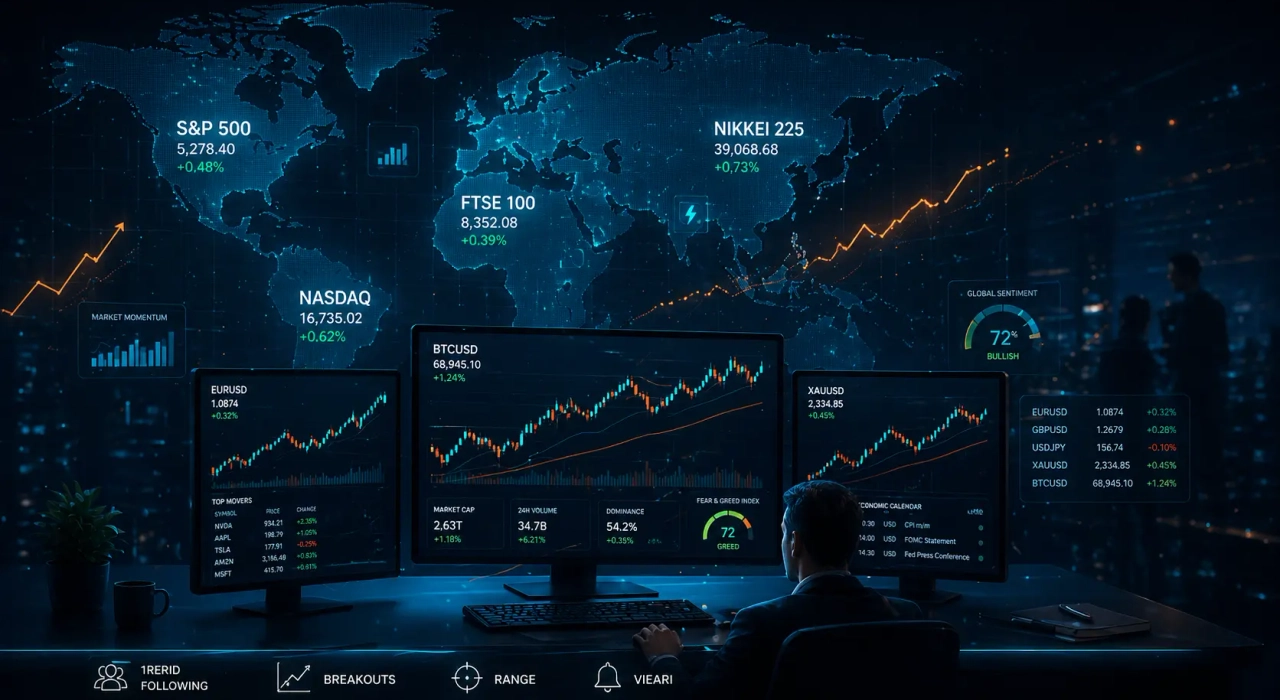
Indices trading strategies is a popular choice for people who want to invest in the market. It allows you to avoid the stress of picking individual stocks. You can trade the performance of entire markets, not just one company. Examples are the S&P 500, NASDAQ, and FTSE 100.
The benefits are obvious. You get a mix of investments. There is high liquidity. You have many opportunities to make money, no matter if the market rises or falls. But to make steady progress with indices, you need more than just enthusiasm. You need strategies that balance risk and reward. This is why understanding indices trading strategies is so important.
Getting Familiar with Indices Trading
An index is a useful tool. It shows how well a group of companies is doing in a market.
- The S&P 500 reflects 500 of the largest US companies.
- The DAX 40 tracks Germany’s most influential firms.
- The Nikkei 225 follows leading Japanese corporations.
When you trade an index, you do not buy every stock. Most traders use tools called CFDs, or Contracts for Difference. These tools help you guess if an index will go up or down without owning the actual shares.
“Indices let traders measure the pulse of the market in a single move.”
Why CFDs Make Indices Attractive
CFDs are especially popular for trading indices because they provide flexibility. Here’s why many traders prefer them:
- Leverage: You can manage bigger positions with less money upfront.
- Profit potential in both directions: Buy when markets go up, sell when they go down.
- Diversification: One trade involves many companies.
- Liquidity: Major indices have high trading volumes. This makes it easier to enter and exit trades.
For day traders, these features are golden. The fast-paced nature of indices CFDs trading fits perfectly with short-term strategies.
Different Indices Trading Strategies
There is no one-size-fits-all formula for success. What works for one trader may not work for another. Still, there are popular strategies in the markets. You can adjust these strategies to match your own style.
Riding the Trend
When the market is moving in one direction, traders usually follow that trend. If the S&P 500 is going up, they buy. If it is going down, they switch to shorting.
Tools that help confirm trends:
- Moving averages (like the 50-day and 200-day)
- MACD for momentum checks
- Simple trendlines
Trading the Range
Not every market trends. Sometimes indices move sideways between support and resistance levels. In those cases, traders buy at the low end of the range and sell near the high end.
Watching for Breakouts
A breakout strategy looks for the moment when price bursts past a key level with volume behind it. This can signal the start of a new trend.
Clues that a breakout may be near:
- Bollinger Bands tightening
- Unusually high trading volume
- Important economic news or earnings
Betting on Mean Reversion
Markets tend to swing back to their average after sharp moves. Traders use tools like RSI and Bollinger Bands to spot when an index might be due for a correction.
Day Trading Stock Indices
Day trading indices means buying and selling trades in the same session. This method works well with price changes and high trading volume.
Advantages include:
- Multiple trading opportunities in a single day
- Smooth execution thanks to deep market volume
- Less single-stock risk compared to trading individual companies
Day traders usually pay attention to:
- The first hour of trading usually has the biggest changes
- Economic news includes things like inflation and job reports
- Short-term scalping strategies use close stop-losses
Indicators That Traders Rely On
To improve their entry and exit points, many traders use technical indicators.
| Indicator | Role in Trading | Example |
| Moving Averages | Spot trends | 50/200-day crossover as bullish signal |
| RSI | Show overbought/oversold | RSI above 70 hints at reversal |
| MACD | Confirm momentum | MACD crossing above signal line |
| Bollinger Bands | Track volatility | Squeeze points to potential breakout |
| Volume Analysis | Validate moves | Spikes confirm breakout strength |
These tools are not perfect, but they help traders understand the big picture better.
Managing Risks
Even the best strategies can fail without risk control. Successful traders understand that protecting their money is as important as making profits.
Ways to manage risk include:
- Restrict every trade to a maximum of 1% or 2% of your total account balance
- Always using stop-losses
- Diversifying across indices instead of overloading on one
- Staying alert to scheduled events that can shake markets
“Risk management isn’t about avoiding losses; it’s about making sure losses don’t take you out of the game.”
Indices CFDs Trading Explained with Real Scenarios
Imagine you expect the FTSE 100 to climb after strong UK banking results. Instead of buying bank shares one by one, you trade a long CFD on the FTSE 100. If the index rises, your CFD gains in value.
Or suppose European markets slump after unexpected news. You could short the DAX 40 using a CFD and benefit from the downside move.
This ability to adapt to both rising and falling markets is a big reason CFDs attract active traders.
Indices Compared with Other Markets
Indices sit somewhere between the volatility of forex and the narrow focus of individual stocks.
| Market Type | Volatility | Common Use | Risk Level |
| Indices | Moderate to high | Diversification, active trading | Medium |
| Stocks | Higher (company risk) | Long-term investing, stock picking | High |
| Forex | Very high | Short-term speculation | High |
| Commodities | Variable | Hedging, speculation | Medium |
Example of a Day Trading Setup
A trader looking at the NASDAQ might:
- Mark key levels before the market opens.
- Watch the open for direction.
- Notice a strong breakout above resistance with high volume.
- Enter long with a stop just below the breakout level.
- Close the trade a few hours later, before market close.
This process highlights why structure and discipline matter more than gut feeling.
The Role of Trader Psychology
Even with solid setups, emotions can ruin trades. Fear of losing or greed for more can push traders to abandon their plans.
Traders who do well usually:
- Accept that not every trade will work
- Stick to rules instead of chasing losses
- Review trades regularly to improve
“In trading, your mindset is as important as your method.”
Putting It All Together
Indices give you direct exposure to entire markets in a single move, no distractions, just opportunity. Whether your edge is trend-following, breakouts, or mean reversion, this is where you put it to work. If you’re serious about progressing as a trader, don’t just explore, take action: start applying your strategy on a live or demo account and turn what you’ve learned into consistent, measurable results.
Frequently Asked Questions
Are indices less risky than stocks?
Yes, because they spread risk across many companies instead of one.
Can a beginner trade indices CFDs?
Definitely, but starting with small positions and practicing first is recommended.
When do indices usually move the most?
The first hours after markets open often bring the most volatility.
Do I need a large account to trade indices?
Not necessarily. CFDs allow smaller positions, though leverage must be used carefully.
Which indices are most popular for day trading?
The S&P 500, NASDAQ 100, DAX 40, and FTSE 100 are common choices.
Community
Trading platforms
Services
Articles
Community
Trading platforms
Services




Copyright © 2026. All rights reserved.
There is a risk of loss in trading foreign currencies and it is not suitable for everyone. Tradeview is not responsible for any gains or losses on currency rates or exchanges during any transaction.
The services and products offered by Tradeview are not being offered within the United States (US) and not being offered to US Persons, as defined under US law. The information on this website is not directed to residents of any country where FX and/or CFDs trading is restricted or prohibited by local laws or regulations.
CFDs are complex instruments and come with a high risk of losing money rapidly due to leverage. 64% of retail investors' accounts lose money when trading CFDs with Tradeview. You should consider whether you understand how CFDs work and whether you can afford to take the high risk of losing your money.
Headquarters Tradeview Ltd.: 13 Genesis Close, 4th Floor, Suite 422, Cayman Islands
High Risk Warning: Foreign exchange trading carries a high level of risk that may not be suitable for all investors. Leverage creates additional risk and loss exposure. Before you decide to trade foreign exchange, carefully consider your investment objectives, experience level, and risk tolerance. You could lose some or all your initial investment; do not invest money that you cannot afford to lose. Educate yourself on the risks associated with foreign exchange trading and seek advice from an independent financial or tax advisor if you have any questions.
Advisory Warning: Tradeview provides references and links to selected blogs and other sources of economic and market information as an educational service to its clients and prospects and does not endorse the opinions or recommendations of the blogs or other sources of information. Clients and prospects are advised to carefully consider the opinions and analysis offered in the blogs or other information sources in the context of the client or prospect's individual analysis and decision making. None of the blogs or other sources of information is to be considered as constituting a track record. Past performance is no guarantee of future results and Tradeview specifically advises clients and prospects to carefully review all claims and representations made by advisors, bloggers, money managers and system vendors before investing any funds or opening an account with any Forex dealer. Any news, opinions, research, data, or other information contained within this website is provided as general market commentary and does not constitute investment or trading advice. Tradeview expressly disclaims any liability for any lost principal or profits without limitation which may arise directly or indirectly from the use of or reliance on such information. As with all such advisory services, past results are never a guarantee of future results.