Index Funds and Trading Isn’t Just About the Money
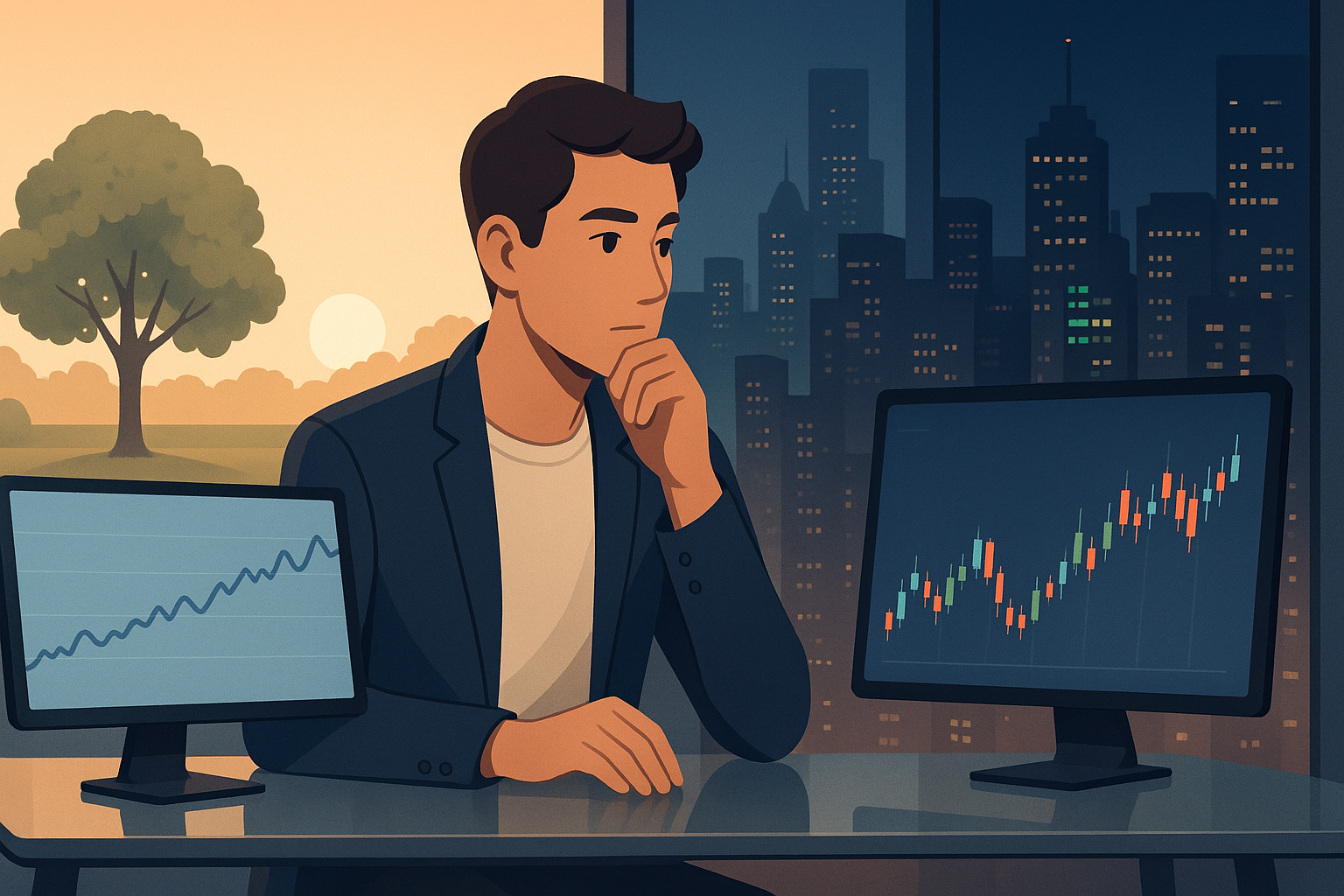
To maximize your savings, consider index funds and trading. Both can grow your wealth but function differently. Index funds are like nurturing a slow-growing tree, while trading resembles starting a business that can quickly succeed or fail.
Let’s break it down in a way that actually makes sense for real life.
The Low-Stress World of Index Funds
Index funds are like the “buy it and forget it” route. You’re basically investing in a giant basket of stocks that mirror a major index, like the S&P 500.
Why People Like Index Funds
- You don’t need to pick individual stocks.
- There’s barely any maintenance.
- The fees are low, sometimes shockingly low.
You’re not trying to outsmart anyone, you’re just going along with the overall market. Over time, that usually works out just fine.
“For people who don’t want investing to take over their life, index funds are a no-brainer,” says personal finance coach Drew Calhoun.
Now, Let’s Talk About Trading
Trading has the opposite vibe. Instead of sitting back, you’re checking prices, watching for news, and using tools like the S&P 500 chart to make quick decisions. You’re buying and selling often, maybe even multiple times a day.
Why Some Folks Love It
- It’s fast, exciting, and hands-on.
- You get to act on instincts and strategy.
- The wins can be big, but the losses can be big too.
If you enjoy the adrenaline of timing your moves and reacting to live news or global indices, this might be more your speed.
A Quick Comparison: Index Funds vs Trading
Here’s a simple chart to show how the two stack up:
| Feature | Index Funds | Trading |
| Risk Level | Lower and spread out | Higher and more focused |
| Time Involvement | Set it and forget it | Daily commitment |
| Learning Curve | Easy to understand | Requires deep knowledge |
| Costs/Fees | Minimal | Can be high (brokerage, taxes, etc.) |
| Tools Used | Basic dashboard | Real-time tools like global indices |
| Type of Growth | Steady over years | Potentially rapid, but inconsistent |
What Happens When Markets Get Weird?
Markets don’t always go up. Sometimes they take a nosedive, and that’s when people panic.
- Index investors usually sit tight. Their portfolio is diversified, so they trust it’ll bounce back.
- Traders are in the action, buying dips or selling fast to protect their cash.
If you trade, you will likely watch global indices live charts. You will track how the markets in Asia, Europe, and the U.S. are moving.
Understanding the S&P 500 Chart (Without Getting a Headache)
Whether you trade or not, this chart is very popular worldwide. It shows how the 500 largest U.S. companies are performing. This gives you a good idea of the overall economy.
What You Can Learn From It
- If the trend is up or down
- Where prices tend to bounce or drop
- If people are optimistic or scared
“The S&P 500 chart is like a mood ring for the stock market,” explains market analyst Rachel Kim. “It tells you what people are feeling without saying a word.”
Real-Life Scenarios: What Does It Look Like Over Time?
Here’s a story many people can relate to:
- Kevin put $8,000 into an index fund tracking the S&P 500 ten years ago. He ignored it. Today, it’s worth almost $24,000.
- Sarah started with the same amount but jumped into trading. She had some wins, some big losses, and ended up with about $10,500 and a lot of stress.
For Kevin, it was boring but effective. Sarah learned a ton but lost sleep over her decisions.
The Mental Game Is Real
This is where things get personal. Ask yourself:
- Are you okay seeing your money go up and down every day?
- Can you sit back and wait, even when headlines are scary?
- Or do you want to be involved, reading charts, checking news, reacting fast?
Index fund investing suits people who want peace of mind. Trading attracts those who enjoy the challenge and don’t mind taking hits for the chance at bigger wins.
Taxes: The Sneaky Part People Forget
- Index funds don’t usually create big taxable events until you sell.
- Traders can get hit with capital gains taxes every time they sell something for a profit.
If you trade in a regular brokerage account, you may owe taxes on each gain. This can happen even if you finish the year with less money than you began with.
How the Tools Differ
Depending on what you choose, your toolkit will look different:
| Tool | Index Fund User | Active Trader |
| Live Market Charts | Not necessary | Vital |
| Global Indices Live | Rarely used | Always monitored |
| Portfolio Tracker | Simple app is fine | Needs advanced tracking |
| Learning Resources | Basic investing guides | In-depth market strategy content |
You Can Keep Risks Manageable
You don’t have to go all-in on either side.
- Want to ease into index funds? Try automatic monthly contributions.
- Curious about trading? Use a small account to practice, and never risk more than you can lose.
It’s not about being fearless, it’s about being smart with how much you put at risk.
“Start small and learn as you go. That applies whether you’re buying an index fund or your first stock,” says finance blogger Will Langford.
Some People Mix Both, and That’s Totally Fine
Many people put most of their money in index funds for safety. They use a smaller amount to trade for fun or to take advantage of opportunities. That way, they get the best of both worlds: stability and excitement.
If you’re just getting started, take a breath and go with what feels manageable. Look at the S&P 500 chart, read up on global indices live, but don’t let information overload paralyze you.
The right move is the one that fits your comfort level, not the one that sounds best on paper.
Frequently Asked Questions
Is one strategy better than the other?
Not really, it depends on your goals and how hands-on you want to be. Index funds are easier and more stable. Trading takes more work but can offer quick gains.
How much money do I need to start with?
For index funds, some trading platforms let you start with as little as $50. For trading, it’s smart to begin small $500 to $1,000 is common for beginners.
Do I need to watch the market every day?
If you’re trading, yes. But if you’re investing in index funds, once a month is plenty.
What if I lose money trading?
Losses happen. Even pros lose sometimes. That’s why it’s important to use stop-loss orders and never bet more than you’re okay with losing.
Can I do this on my phone?
Absolutely. Most investing apps now offer both index fund options and live trading features, including charts, real-time updates, and global index tracking.How can I keep track of global market movements?
Use tools that offer global indices live tracking, so you always know what’s happening across the major world markets.
Community
Trading platforms
Services
Articles
Community
Trading platforms
Services




Copyright © 2026. All rights reserved.
There is a risk of loss in trading foreign currencies and it is not suitable for everyone. Tradeview is not responsible for any gains or losses on currency rates or exchanges during any transaction.
The services and products offered by Tradeview are not being offered within the United States (US) and not being offered to US Persons, as defined under US law. The information on this website is not directed to residents of any country where FX and/or CFDs trading is restricted or prohibited by local laws or regulations.
CFDs are complex instruments and come with a high risk of losing money rapidly due to leverage. 64% of retail investors' accounts lose money when trading CFDs with Tradeview. You should consider whether you understand how CFDs work and whether you can afford to take the high risk of losing your money.
Headquarters Tradeview Ltd.: 13 Genesis Close, 4th Floor, Suite 422, Cayman Islands, KY1-1110
High Risk Warning: Foreign exchange trading carries a high level of risk that may not be suitable for all investors. Leverage creates additional risk and loss exposure. Before you decide to trade foreign exchange, carefully consider your investment objectives, experience level, and risk tolerance. You could lose some or all your initial investment; do not invest money that you cannot afford to lose. Educate yourself on the risks associated with foreign exchange trading and seek advice from an independent financial or tax advisor if you have any questions.
Advisory Warning: Tradeview provides references and links to selected blogs and other sources of economic and market information as an educational service to its clients and prospects and does not endorse the opinions or recommendations of the blogs or other sources of information. Clients and prospects are advised to carefully consider the opinions and analysis offered in the blogs or other information sources in the context of the client or prospect's individual analysis and decision making. None of the blogs or other sources of information is to be considered as constituting a track record. Past performance is no guarantee of future results and Tradeview specifically advises clients and prospects to carefully review all claims and representations made by advisors, bloggers, money managers and system vendors before investing any funds or opening an account with any Forex dealer. Any news, opinions, research, data, or other information contained within this website is provided as general market commentary and does not constitute investment or trading advice. Tradeview expressly disclaims any liability for any lost principal or profits without limitation which may arise directly or indirectly from the use of or reliance on such information. As with all such advisory services, past results are never a guarantee of future results.