Please note that deposits and withdrawals via Bitwallet are no longer available. Please use alternative methods going forward.
Futures You Can Trade That Fit Any Market Outlook
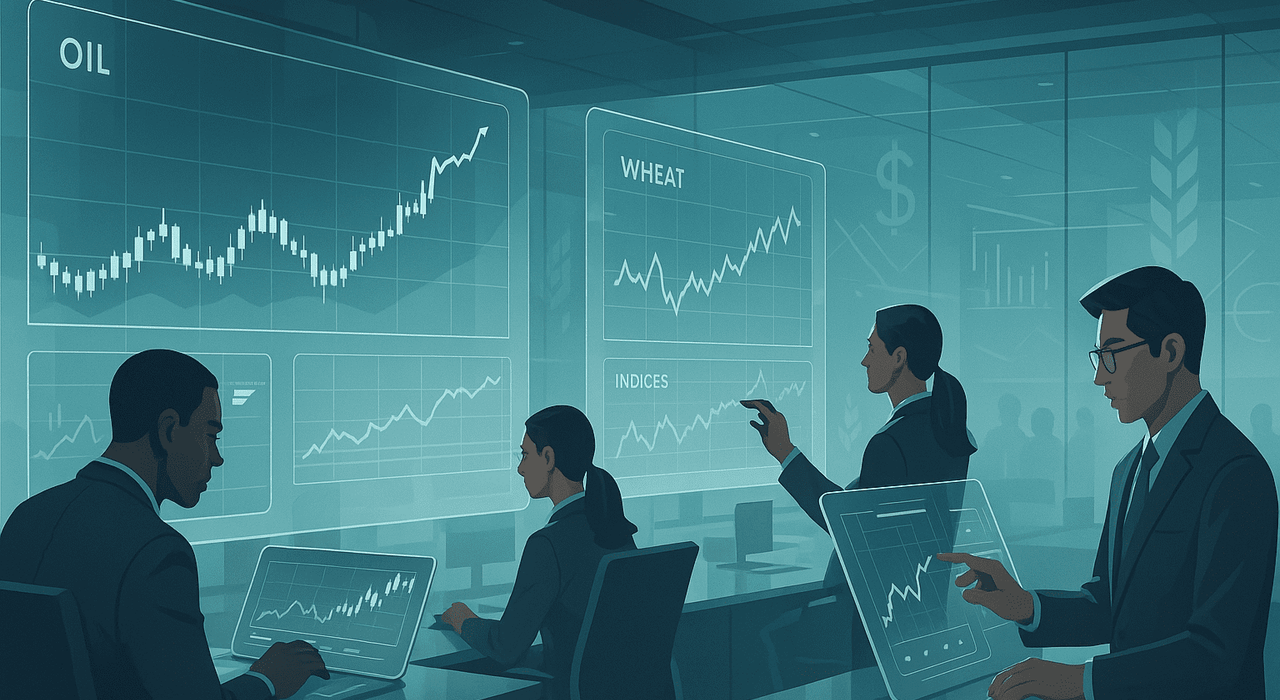
If you’re looking to trade beyond stocks or crypto, consider futures, which include assets like oil, gold, wheat, and the S&P 500. A futures contract is a legal agreement to buy or sell an asset at a predetermined price for a future date.
These contracts are traded every day. Prices change often, so you can enter and exit positions whenever you want.
Choosing the Right Futures Contracts
Get familiar with size and tick value
Each futures contract comes with its own set of rules. Take crude oil: one contract covers 1,000 barrels, and each small price move called a “tick” is worth $10. Gold covers 100 ounces, also with a $10 tick. It’s a bit like poker: you need to know the stakes before you sit at the table.
Liquidity really matters
Want to make sure you can buy and sell without any drama? Stick with contracts that have lots of daily volume like the E-mini S&P 500 or crude oil. These are trader favorites for a reason: they’re fast-moving, tight-spread, and always buzzing.
Match the market to your style
Some contracts are more seasonal like natural gas (hello, winter heating bills) or corn (all about the harvest). Others, like financial futures, react to interest rate news and macro events. Picking the right one depends on what you’re tracking and how often you want to trade.
Real Strategies That Actually Work
Ride the trend
When prices break out of a range, pros often hop on for the ride. Use tools like moving averages or RSI to spot the move, then trail your stop so you can ride the wave without risking a wipeout.
Play the spread
You don’t have to just go long or short. You can trade two related futures at once like going long crude oil and short heating oil. It’s a clever way to focus on relative moves, not just big headlines.
Bet on reversions
Some traders wait for prices to drift far from the average then bet they’ll come back. It’s called mean reversion, and while it’s more math-heavy, it works well in calmer markets.
Where Trade Futures Without Hassle
If you’re wondering where trade futures, you’ve got some solid options:
- Big exchanges like CME, ICE, and Eurex
- Online brokers
- Prop trading firms or hedge funds (if you’re leveling up)
Some brokers offer access to many markets, real-time data, and easy-to-use tools. All of this is on a simple platform that is easy to understand. Look for brokers that offer tight spreads, fast execution, and good support, especially if you’re new.
A Day in the Life of a Futures Trade
Let’s say oil is heating up. Demand’s rising, inventories are falling, and price just broke a key resistance. You spot the breakout and make a plan:
- Enter just above the breakout level
- Set a stop a few ticks below your entry
- Keep your position size small to manage risk
- Trail your stop as the price climbs
- Take partial profits early, then let the rest ride
This isn’t fantasy. This is exactly how skilled traders operate: calculated risk, thoughtful entry, and exits that make sense.
Managing Risk Like It’s Your Job
- Only risk 1–2% of your capital per trade
- Spread your trades don’t put it all on oil or corn
- Walk away when things go south. Revenge trading kills accounts.
Here’s a quick example: with $10,000 in your account, risking 1% means $100 per trade. If the contract’s tick is worth $10, that gives you a 10-tick stop. Keep it simple and stick to it.
The Tools That Make It Easier
Charting and indicators
You don’t need a PhD to trade, but you do need tools. Brokers with Futures give you charts, indicators, and backtesting so you’re not flying blind.
Stay in the loop
Futures markets move fast. Economic calendars, crop reports, Fed announcements they all matter. Make sure your platform alerts you when the big stuff hits.
Practice before you leap
Before you risk real money, run a few demo trades. Most brokers let you simulate trades so you can build confidence. It’s like batting practice: nobody wins a championship their first time at bat.
Quick Look: Top Futures at a Glance
| Market | Contract Size | Tick Value | Great For |
| Crude Oil (CL) | 1,000 barrels | $10 | Macro/news traders |
| Gold (GC) | 100 ounces | $10 | Inflation hedging |
| Corn (ZC) | 5,000 bushels | $12.50 | Seasonal trends |
| S&P E-mini (ES) | 50 index points | $12.50 | Day/swing trading |
| Natural Gas (NG) | 10,000 MMBtu | $10 | Weather-driven trades |
Some Hard-Earned Tips
- Know when your contract expires don’t get caught in delivery
- Track margin requirements and adjust your size accordingly
- Avoid trading during low-liquidity hours (like 2 a.m. EST)
- Always have an exit plan no one wins guessing
Curious About Trading Futures?
If you are uncertain, consider signing up for a free account on a platform. You can explore a few demo trades and observe some active markets in real time. Once you see how futures move and how clear the opportunity is you might just find your next edge.
FAQs
What are the most common futures you can trade?
Crude oil, gold, corn, natural gas, and stock indices like the S&P 500 are some of the most active and accessible contracts.
Can I start trading futures with a small account?
Yes. Many brokers offer micro contracts and low margins, letting you get started with less risk while you learn.
How to trade futures like a pro without years of experience?
Keep it simple. Use a repeatable strategy, control your risk, and learn from every trade even the losers.
Where to trade futures if I want good tools and low fees?
Look for brokers that offer great tools, tight spreads, and lots of contract options.
Are futures good for long-term investing?
They’re better for short- to medium-term trades. Long-term investors might prefer ETFs unless they’re using futures for hedging.
Do I need to take delivery of commodities?
Nope. Nearly all futures traders close their positions before delivery dates. You’re not getting a truckload of corn on your doorstep.
Community
Trading platforms
Services
Articles
Community
Trading platforms
Services




Copyright © 2026. All rights reserved.
There is a risk of loss in trading foreign currencies and it is not suitable for everyone. Tradeview is not responsible for any gains or losses on currency rates or exchanges during any transaction.
The services and products offered by Tradeview are not being offered within the United States (US) and not being offered to US Persons, as defined under US law. The information on this website is not directed to residents of any country where FX and/or CFDs trading is restricted or prohibited by local laws or regulations.
CFDs are complex instruments and come with a high risk of losing money rapidly due to leverage. 64% of retail investors' accounts lose money when trading CFDs with Tradeview. You should consider whether you understand how CFDs work and whether you can afford to take the high risk of losing your money.
Headquarters Tradeview Ltd.: 13 Genesis Close, 4th Floor, Suite 422, Cayman Islands
High Risk Warning: Foreign exchange trading carries a high level of risk that may not be suitable for all investors. Leverage creates additional risk and loss exposure. Before you decide to trade foreign exchange, carefully consider your investment objectives, experience level, and risk tolerance. You could lose some or all your initial investment; do not invest money that you cannot afford to lose. Educate yourself on the risks associated with foreign exchange trading and seek advice from an independent financial or tax advisor if you have any questions.
Advisory Warning: Tradeview provides references and links to selected blogs and other sources of economic and market information as an educational service to its clients and prospects and does not endorse the opinions or recommendations of the blogs or other sources of information. Clients and prospects are advised to carefully consider the opinions and analysis offered in the blogs or other information sources in the context of the client or prospect's individual analysis and decision making. None of the blogs or other sources of information is to be considered as constituting a track record. Past performance is no guarantee of future results and Tradeview specifically advises clients and prospects to carefully review all claims and representations made by advisors, bloggers, money managers and system vendors before investing any funds or opening an account with any Forex dealer. Any news, opinions, research, data, or other information contained within this website is provided as general market commentary and does not constitute investment or trading advice. Tradeview expressly disclaims any liability for any lost principal or profits without limitation which may arise directly or indirectly from the use of or reliance on such information. As with all such advisory services, past results are never a guarantee of future results.