Please note that deposits and withdrawals via Bitwallet are no longer available. Please use alternative methods going forward.
Futures Trading Hours 2026: Simplified Across Every Exchange
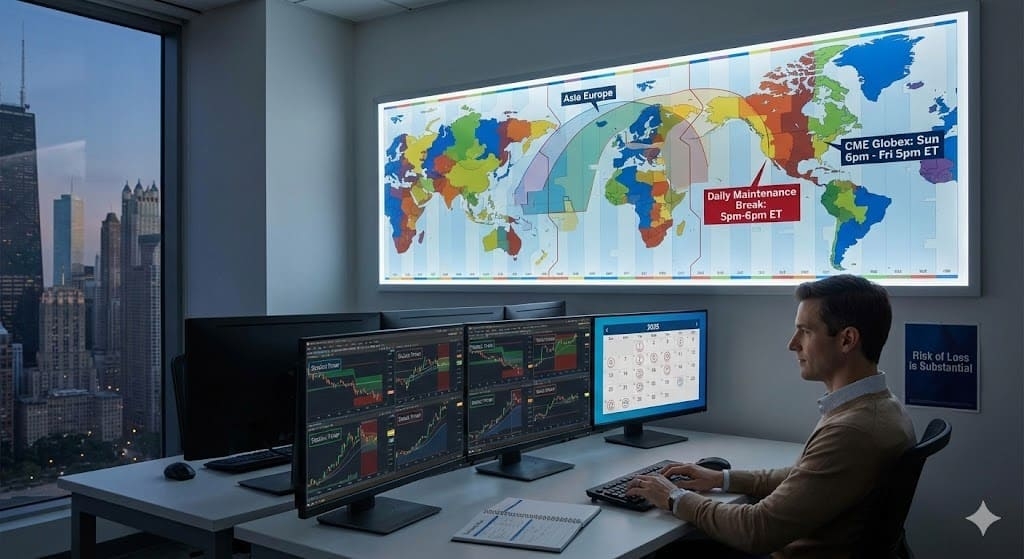
Quick answer: Most U.S. futures trade almost around the clock. CME Globex runs Sunday 6:00 p.m. to Friday 5:00 p.m. ET with a 60-minute daily maintenance break, while ICE Futures Europe and Eurex follow their own regional windows. Liquidity still concentrates around the U.S., London, and Asia cash sessions — know the exchange rhythm first, then pick your trading window.
Screens blink, liquidity shifts, and the clock matters more than opinions. This is a clean map of futures trading hours, the windows that actually move prices, and what the best futures trading platform should surface so you can act calmly instead of guessing.
“CME Globex runs Sunday 6:00 p.m. to Friday 5:00 p.m. ET with a 60-minute daily break.”
The landscape in plain English
Near-24 hour access does not mean constant liquidity. Volume and spreads change by venue and by region. Know the exchange rhythm first; pick your trading window second.
Core venue windows you’ll care about
| Venue & product examples | Typical electronic hours (local) | Notes you can trade on |
| CME Globex (ES, NQ, CL, GC, ZN) | Sun 6:00 p.m. to Fri 5:00 p.m. ET, daily maintenance 5:00-6:00 p.m. ET | Most CME contracts follow this pattern; check product pages for exceptions. |
| ICE Futures Europe (Brent) | New York 8:00 p.m.-6:00 p.m. (next day) | Sunday pre-open and precise city schedules are listed on the product page. |
| Eurex (DAX, Euro-STOXX) | Regular 08:00-22:00 CET; Asian hours 01:00-08:00 CET for select futures | Designed to capture Asia-Europe-US flows. |
| Cboe Futures Exchange – CFE (VX, VXM) | Sun-Thu pre-open ~4:45 p.m. CT, open 5:00 p.m. CT, close ~4:00 p.m. CT next session | Shorter daily window than equity index futures; expiration weeks shift the close – check the product page. |
“The risk of loss in trading commodity futures contracts can be substantial.” Keep that pinned above your monitor.
Regular Trading Hours vs. Electronic Trading Hours
Two labels get thrown around loosely. Regular Trading Hours (RTH) is the daytime cash-market window most charts default to – for U.S. equity index futures that’s roughly 9:30 a.m. to 4:15 p.m. ET. Electronic Trading Hours (ETH) is the full near-24-hour Globex session, including the overnight leg. If your strategy relies on opening-range or VWAP signals anchored to the cash open, mixing ETH bars into that calculation quietly distorts the read. Confirm which window your charting platform defaults to before you back-test anything.
Session rhythm you can actually use
| Window (ET) | What usually happens | Practical move |
| 7:00 p.m.-11:00 p.m. | Asia opens, CME thinner than U.S. daytime | Trade smaller; favor retests over first breaks |
| 2:00 a.m.-5:00 a.m. | Europe cash ramp; spreads tighten | Let levels confirm, then size modestly |
| 9:30 a.m.-11:30 a.m. | U.S. cash session; strongest pace | Use pre-planned brackets; avoid improvisation |
| 3:30 p.m.-4:00 p.m. | U.S. close; rebalancing | Reduce size; exits should be mechanical |
| 5:00 p.m.-6:00 p.m. | Daily maintenance for CME | No trades; review and set alerts for re-open. |
Global market overlaps: Asia, Europe, and the U.S.
Liquidity in futures doesn’t arrive evenly – it arrives in waves as one region’s cash session hands off to the next. Tokyo and Hong Kong set the tone during the Asia leg, roughly 7:00 p.m. to 2:00 a.m. ET. London’s open near 3:00 a.m. ET tightens spreads on European indices and energy. The heaviest overlap of the day runs from about 8:00 a.m. to 11:00 a.m. ET, when London is still active and U.S. participants are positioning into the 9:30 a.m. cash open – this window consistently produces the tightest spreads and cleanest breaks of the session. Trading outside these overlaps isn’t wrong, but expect to size down and widen your stops.
Holiday and maintenance schedule for 2026
Exchanges publish special schedules for holidays and daylight-saving shifts, and your platform should reflect those automatically in your local time zone. U.S. futures markets typically close or shorten trading around New Year’s Day, Martin Luther King Jr. Day, Presidents’ Day, Good Friday, Memorial Day, Juneteenth, Independence Day, Labor Day, Thanksgiving, and Christmas, with early closes common on the trading day immediately before or after the holiday itself. Exact 2026 dates and closing times vary slightly by product and exchange, so verify against the CME Group holiday calendar or the Cboe hours and holidays page before a big week rather than relying on a generic list.
Platform traits that matter more than logos
If you want the best futures trading platform, judge it by what it changes in your decisions. Our roundup of futures trading platforms breaks down the options – whether you trade on MetaTrader 5, cTrader, CQG Desktop, or DAS Trader, look for:
- Visible session timers and maintenance breaks synchronized to your locale
- One-click brackets (entry, stop, target) that attach on every order
- Exportable fills with venue tags and timestamps for review
- Calendar overlay for economic releases during your chosen window
Trading hours by asset class (cheat-sheet)
Not every futures product follows the equity-index pattern. Here’s how the major asset classes differ:
| Asset class | Representative contracts | Typical electronic hours | What’s different |
| Equity index & micros | ES, NQ, YM, RTY, MES, MNQ | Sun 6:00 p.m.-Fri 5:00 p.m. ET, daily break 5-6 p.m. ET | Deepest liquidity of any futures group; heaviest volume during U.S. cash hours |
| Energy | CL (WTI), Brent (ICE), NG | Same near-24h pattern for CL/NG; Brent follows ICE’s London-anchored window | Price-sensitive to London and Middle East session news |
| Metals | GC (Gold), SI (Silver), HG (Copper) | Sun 6:00 p.m.-Fri 5:00 p.m. ET, daily break 5-6 p.m. ET | Often quieter overnight than equity index futures despite the same nominal hours |
| Agriculture | ZC (Corn), ZS (Soybeans), ZW (Wheat) | Split session: roughly 7:00 p.m.-7:45 a.m. CT overnight, then 8:30 a.m.-1:20 p.m. CT daytime | Shorter effective trading day; the legacy daytime window still drives most volume |
| Livestock | LE (Live Cattle), HE (Lean Hogs) | Roughly 8:30 a.m.-1:05 p.m. CT, Monday-Friday only | No meaningful overnight session – closes evenings and weekends |
| Currencies & crypto | 6E, 6B, 6A, BTC, ETH | Sun 6:00 p.m.-Fri 5:00 p.m. ET, daily break 5-6 p.m. ET | Crypto futures share the CME calendar and close on weekends – spot crypto does not |
| Volatility (CFE) | VX, VXM | Shorter daily window than equity index futures; pre-open ~4:45 p.m. CT | Tied to SPX settlement mechanics, not a simple mirror of ES hours |
Hours vary by exact contract and shift around holidays – confirm on the exchange’s product page before you trade.
A tiny two-week plan that pays you back
- Pick one contract and one two-hour window that matches your day.
- Trade at half size for ten sessions; log quoted spread, traded spread, and slippage by minute.
- Keep the window where your notebook shows tighter spreads and fewer mistakes.
Before the FAQ, one nudge. If this rhythm fits, mark your futures trading window on a calendar, enable session timers, and set brackets as default. A calm routine beats a bigger watchlist.
FAQ
Do all contracts follow the same electronic schedule?
No. Many CME products share the 6:00 p.m.-5:00 p.m. ET pattern with a daily break, but ICE, Eurex, agricultural, livestock, and CFE contracts have product-specific details. Always check the product page.
What’s the difference between regular trading hours and electronic trading hours?
Regular Trading Hours (RTH) is the daytime cash-session window – for ES that’s roughly 9:30 a.m.-4:15 p.m. ET. Electronic Trading Hours (ETH) covers the full near-24-hour Globex session. Most opening-range and VWAP strategies are anchored to RTH, while overnight ETH bars are typically excluded from intraday signals.
Are overnight hours good for beginners?
Liquidity is thinner and slippage bites harder. Start with your daytime region and move outward once your logs look steady – our guide to day trading futures walks through that progression.
Do futures trade on weekends?
No. Most CME Globex products close Friday at 5:00 p.m. ET and reopen Sunday at 6:00 p.m. ET. That weekend pause matters for overnight risk sizing even on “near-24-hour” products.
Are cryptocurrency futures open 24/7?
No, even though spot crypto trades continuously. CME-listed Bitcoin and Ether futures follow the same Globex schedule as other CME products, including the Friday-to-Sunday weekend close.
What are the trading hours for agricultural and livestock futures?
Grains like corn, soybeans, and wheat trade a split session – roughly 7:00 p.m. to 7:45 a.m. CT overnight, then 8:30 a.m. to 1:20 p.m. CT during the day. Livestock futures such as live cattle and lean hogs trade a shorter daytime-only window, roughly 8:30 a.m. to 1:05 p.m. CT, Monday through Friday.
Does platform choice change fills?
It changes routes, risk tools, and timing. The best futures trading platform makes maintenance windows obvious, attaches risk by default, and lets you audit fills quickly.
Where do official holiday schedules live?
On the exchange’s trading-hours page (for example, CME lists product and holiday hours in one place, and Cboe publishes a separate calendar for CFE products like VIX futures).
Community
Trading platforms
Services
Articles
Community
Trading platforms
Services




Copyright © 2026. All rights reserved.
There is a risk of loss in trading foreign currencies and it is not suitable for everyone. Tradeview is not responsible for any gains or losses on currency rates or exchanges during any transaction.
The services and products offered by Tradeview are not being offered within the United States (US) and not being offered to US Persons, as defined under US law. The information on this website is not directed to residents of any country where FX and/or CFDs trading is restricted or prohibited by local laws or regulations.
CFDs are complex instruments and come with a high risk of losing money rapidly due to leverage. 64% of retail investors' accounts lose money when trading CFDs with Tradeview. You should consider whether you understand how CFDs work and whether you can afford to take the high risk of losing your money.
Headquarters Tradeview Ltd.: 13 Genesis Close, 4th Floor, Suite 422, Cayman Islands
High Risk Warning: Foreign exchange trading carries a high level of risk that may not be suitable for all investors. Leverage creates additional risk and loss exposure. Before you decide to trade foreign exchange, carefully consider your investment objectives, experience level, and risk tolerance. You could lose some or all your initial investment; do not invest money that you cannot afford to lose. Educate yourself on the risks associated with foreign exchange trading and seek advice from an independent financial or tax advisor if you have any questions.
Advisory Warning: Tradeview provides references and links to selected blogs and other sources of economic and market information as an educational service to its clients and prospects and does not endorse the opinions or recommendations of the blogs or other sources of information. Clients and prospects are advised to carefully consider the opinions and analysis offered in the blogs or other information sources in the context of the client or prospect's individual analysis and decision making. None of the blogs or other sources of information is to be considered as constituting a track record. Past performance is no guarantee of future results and Tradeview specifically advises clients and prospects to carefully review all claims and representations made by advisors, bloggers, money managers and system vendors before investing any funds or opening an account with any Forex dealer. Any news, opinions, research, data, or other information contained within this website is provided as general market commentary and does not constitute investment or trading advice. Tradeview expressly disclaims any liability for any lost principal or profits without limitation which may arise directly or indirectly from the use of or reliance on such information. As with all such advisory services, past results are never a guarantee of future results.