Please note that deposits and withdrawals via Bitwallet are no longer available. Please use alternative methods going forward.
Day Trading for Beginners: How to Start Safely

Day trading means opening and closing all your positions within the same day, so you never hold a trade overnight. It is fast, demanding, and one of the hardest ways to make money in the markets — most beginners lose at first. This guide covers what day trading is, how it works, the strategies, the real risks, and the exact steps to start without blowing up your account.
What is day trading?
Day trading is a short-term style where you buy and sell the same asset within a single trading day. You aim to profit from small price moves, often holding a position for minutes rather than days. Because every trade is closed by the session’s end, you carry no overnight risk and pay no overnight swap fees.
Day traders work across forex, stocks, indices, and commodities. The common thread is liquidity and volatility — you need enough movement to profit and enough volume to enter and exit fast. Major forex pairs like EUR/USD and large-cap stocks are popular for exactly this reason.
How day trading works
A day trader repeats a simple loop, many times a day:
- Scan for a setup — a chart pattern, a breakout, or a news catalyst.
- Enter with a plan — a defined entry, a stop-loss, and a profit target before the trade.
- Manage the position — let the target or the stop do the work; avoid moving the stop out of hope.
- Close and review — exit within the day, log the result, and repeat.
Most day traders take 3 to 10 trades a day and rely on short timeframes — the 1-minute to 15-minute charts. The London–New York overlap (roughly 8am to 12pm ET) is the busiest window for forex, when volume and volatility peak.
Day trading vs other styles
Day trading sits in the middle of the speed spectrum — faster than swing trading, slower than scalping.
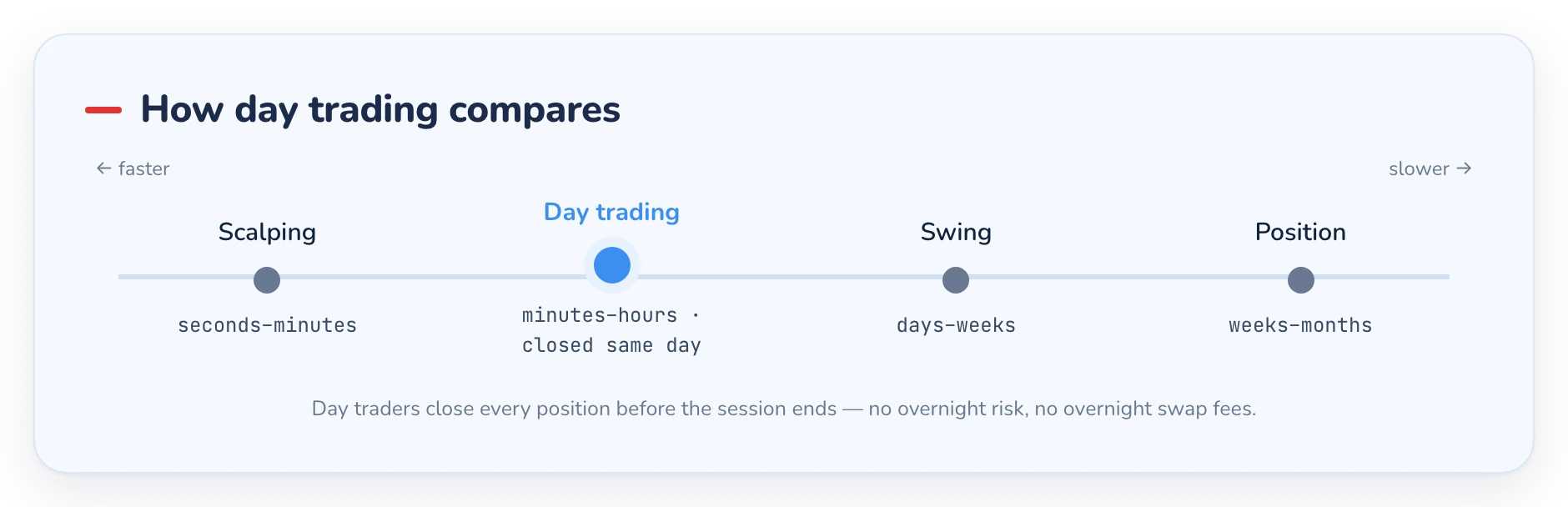
- Scalping — seconds to minutes, dozens of trades a day, the highest effort.
- Day trading — minutes to hours, all closed by end of day.
- Swing trading — days to weeks; far less screen time, but overnight risk.
- Position trading — weeks to months; the slowest, most hands-off.
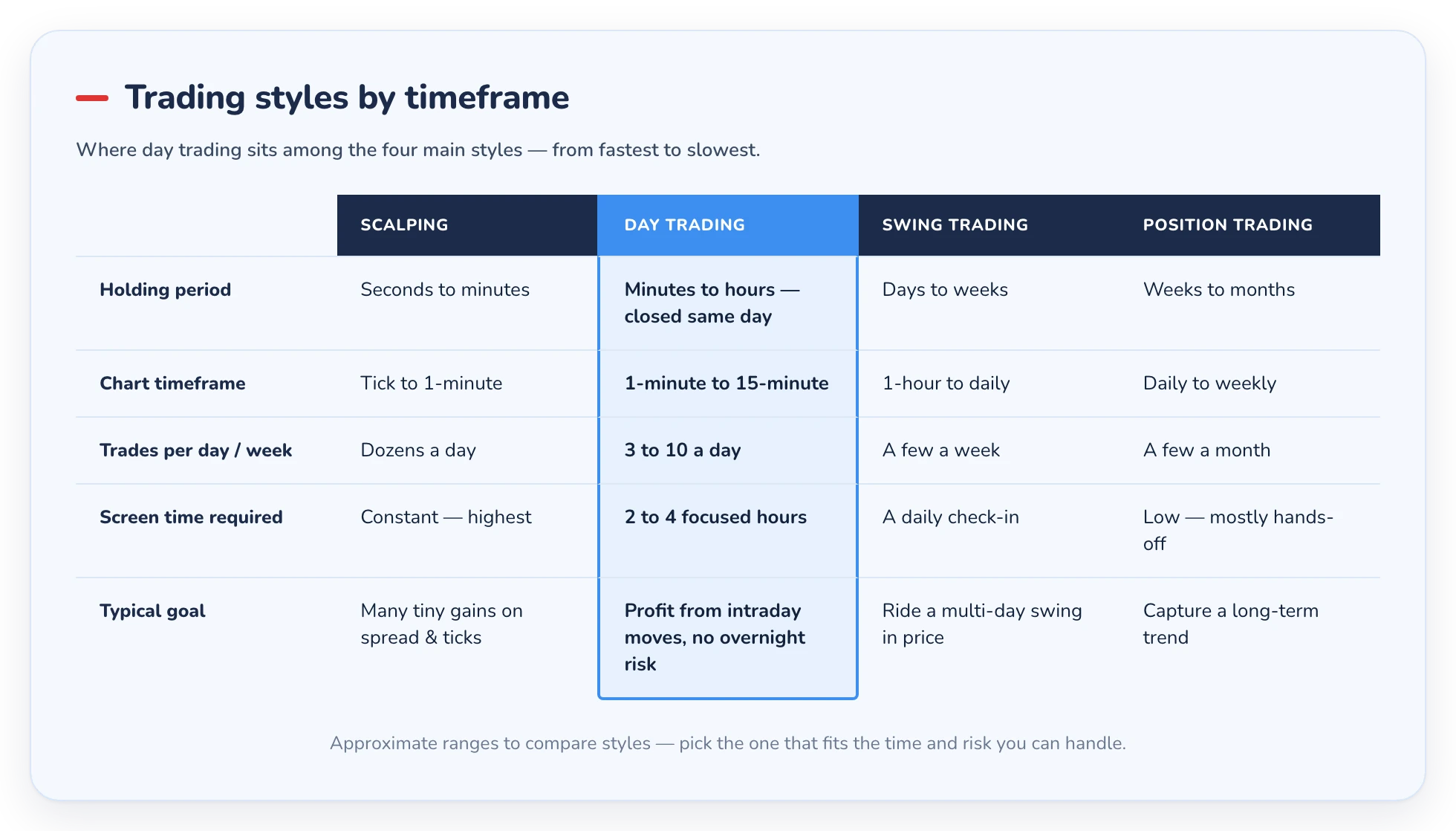
If you cannot watch the screen for a few hours a day, swing trading usually fits better.
The rules that keep you in the game
Skill matters, but survival comes first. These rules protect your capital:
- Risk 1% or less per trade. On a $5,000 account, that caps risk at $50 a trade. A losing streak stings but never wipes you out. Tradeview’s position size calculator makes this quick to check before every trade.
- Always set a stop-loss. Decide your exit before you enter, and let the order execute it. Hope is not a plan.
- Cap your daily loss. Many pros stop trading after losing 2–3% in a day. Walking away protects tomorrow’s capital.
- Aim for a positive reward-to-risk ratio. Target at least 1.5–2× your risk, so you can be right less than half the time and still profit.
The $25,000 Myth. The Pattern Day Trader (PDT) rule is US-specific and widely misunderstood. Placing four or more day trades in five business days in a margin account flags it as a Pattern Day Trader account, which then requires a $25,000 minimum balance. It applies to US stock margin accounts only — cash accounts, forex, and CFDs are not subject to it, so you do not need $25,000 to start.
A worked example
Run the Numbers. Say you have a $5,000 account and risk 1% — that is $50 per trade. You spot a breakout on EUR/USD and set a stop 10 pips away. On a mini lot (0.10), each pip is worth about $1, so a 10-pip stop risks roughly $10; you size up to about 0.50 lots to reach your $50 limit. You target 20 pips — a 2:1 reward. Win, and you make about $100; lose, and you are down $50. Trade this way and a 45% win rate still turns a profit, because your winners are twice your losers. That math, not a magic indicator, is the real edge.
(Illustrative — pip value varies by pair and lot size; not a profit projection.)
Popular day trading strategies
- Momentum trading — you ride a strong move driven by news or volume, entering as it accelerates.
- Breakout trading — you enter when price clears a clear support or resistance level.
- Reversal trading — you fade an overextended move, using tools like the RSI (below 30 or above 70) for confirmation. This is higher-risk and better left until you have experience.
- Range trading — in quiet markets, you buy near support and sell near resistance.
Start with one strategy, not five. Trade it on a demo account until the rules feel automatic.
What you need to start
- A funded account you can afford to lose. Many brokers let you start small; more capital simply gives you room to size trades sensibly.
- A fast, stable platform. Day trading needs quick execution and reliable charts. Tradeview Markets offers the MetaTrader and cTrader platforms, with the order types and indicators day traders rely on.
- A demo account. Practice with virtual funds first — prove a strategy works for you before risking real money.
- A trading journal. Log every trade. Reviewing your wins and losses is how you actually improve.
Is day trading profitable? The honest answer
It can be, but the odds are against beginners. Studies consistently show most day traders lose money — one analysis of Brazil’s futures market found 97% of persistent day traders lost money, especially in their first year. Trading costs — spreads and commissions on every trade — add up fast when you trade often. Leverage magnifies both gains and losses. The traders who last treat it as a business: strict risk limits, one tested strategy, and relentless review. Treat it as a get-rich-quick scheme and it becomes a fast way to lose your deposit.
Mind the Undertow. Day trading is high-risk and time-intensive. You can lose money quickly, including more than you expect when using leverage. Only trade money you can afford to lose.
How to start day trading with Tradeview Markets
- Open a demo account and pick one strategy from this guide to test.
- Trade it on the MetaTrader or cTrader platforms until you are consistent.
- Set your risk per trade (1% or less) and attach a stop-loss to every position.
- When you are steadily profitable on demo, open a live account and start small.
Frequently asked questions
How much money do I need to start day trading?
It depends on the market. Day trading US stocks requires a $25,000 minimum under the Pattern Day Trader rule, but forex and CFDs have no such requirement — many traders start with a few hundred dollars. A larger balance mainly gives you room to size trades sensibly.
Is day trading good for beginners?
It is one of the harder ways to start, because it demands fast decisions and constant focus. Many beginners do better learning on slower timeframes first. If you do day trade, start on a demo account and risk tiny amounts.
Can you make a living day trading?
A small minority do, after years of practice and strict discipline. Most people who try do not. Treat any early profits as tuition, not income, until you have a long, consistent track record.
How many hours a day do day traders work?
Often just 2–4 focused hours, timed to the most active market session. But the screen time is intense, and preparation and review add more.
What is the best strategy for beginner day traders?
Momentum and breakout trading are common starting points because they work with the market’s direction. The best strategy is the one you can follow consistently with firm risk control.
Sources
- Chague, F., De-Losso, R., & Giovannetti, B. (2020). Day Trading for a Living? Of persistent retail day traders in Brazil, 97% lost money. papers.ssrn.com
- Barber, B. M., & Odean, T. (2000). Trading Is Hazardous to Your Wealth: The Common Stock Investment Performance of Individual Investors. The Journal of Finance, 55(2), 773–806. doi.org
Risk warning. Trading Forex and CFDs carries a high level of risk and may not be suitable for all investors. Leverage can work against you as well as for you. The strategies described are educational examples, not trading advice, and past performance is not indicative of future results. This article is for educational purposes only and does not constitute financial advice.
Community
Trading platforms
Services
Articles
Community
Trading platforms
Services




Copyright © 2026. All rights reserved.
There is a risk of loss in trading foreign currencies and it is not suitable for everyone. Tradeview is not responsible for any gains or losses on currency rates or exchanges during any transaction.
The services and products offered by Tradeview are not being offered within the United States (US) and not being offered to US Persons, as defined under US law. The information on this website is not directed to residents of any country where FX and/or CFDs trading is restricted or prohibited by local laws or regulations.
CFDs are complex instruments and come with a high risk of losing money rapidly due to leverage. 64% of retail investors' accounts lose money when trading CFDs with Tradeview. You should consider whether you understand how CFDs work and whether you can afford to take the high risk of losing your money.
Headquarters Tradeview Ltd.: 13 Genesis Close, 4th Floor, Suite 422, Cayman Islands
High Risk Warning: Foreign exchange trading carries a high level of risk that may not be suitable for all investors. Leverage creates additional risk and loss exposure. Before you decide to trade foreign exchange, carefully consider your investment objectives, experience level, and risk tolerance. You could lose some or all your initial investment; do not invest money that you cannot afford to lose. Educate yourself on the risks associated with foreign exchange trading and seek advice from an independent financial or tax advisor if you have any questions.
Advisory Warning: Tradeview provides references and links to selected blogs and other sources of economic and market information as an educational service to its clients and prospects and does not endorse the opinions or recommendations of the blogs or other sources of information. Clients and prospects are advised to carefully consider the opinions and analysis offered in the blogs or other information sources in the context of the client or prospect's individual analysis and decision making. None of the blogs or other sources of information is to be considered as constituting a track record. Past performance is no guarantee of future results and Tradeview specifically advises clients and prospects to carefully review all claims and representations made by advisors, bloggers, money managers and system vendors before investing any funds or opening an account with any Forex dealer. Any news, opinions, research, data, or other information contained within this website is provided as general market commentary and does not constitute investment or trading advice. Tradeview expressly disclaims any liability for any lost principal or profits without limitation which may arise directly or indirectly from the use of or reliance on such information. As with all such advisory services, past results are never a guarantee of future results.