Best Indices to Trade Without Overcomplicating It
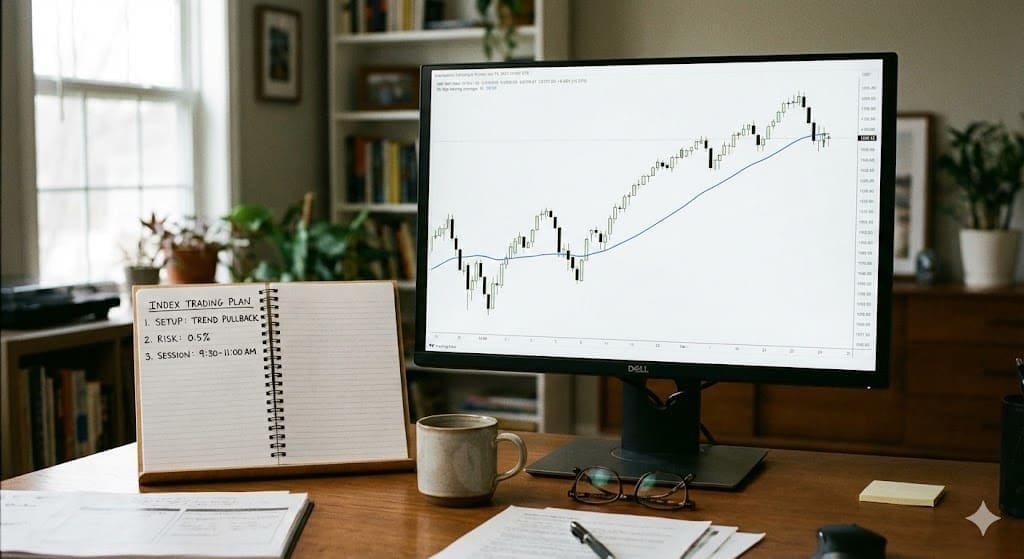
Indices are popular for a reason: they bundle a market story into a single instrument. Instead of researching 40 individual stocks, you can trade the index that represents the theme. You get liquidity, cleaner technical behavior than many single names, and a market that usually respects key levels because so many participants are watching the same thing.
Still, “popular” doesn’t automatically mean “easy.” Picking the best indices to trade depends on how you trade, when you trade, and how you manage risk. The same index can feel smooth in one session and chaotic in another.
“An index is a crowd. Your job is to trade the crowd’s behavior, not its headlines.” (Trading note)
This guide explains how to choose the best indices to trade, how to trade global indices online in a structured way, and a practical approach to indices trading for all experience levels.
Why indices trading can be simpler than single stocks
Indices often behave more “technically” because:
- They are heavily traded by institutions, funds, and hedgers
- Liquidity is typically deeper than individual names
- They reflect broad risk sentiment, which creates clearer directional phases
- Single-stock surprises (earnings, scandals) are diversified away
That does not mean indices are low-risk. It means the risk is more often tied to macro shifts, news events, and session volatility rather than a single company shock.
The real criteria for the best indices to trade
Instead of starting with a list, start with criteria. This prevents the common mistake of choosing an index because it’s famous, then realizing the trading hours don’t match your schedule.
1) Liquidity where you trade
The best indices to trade are the ones that have reliable liquidity during your trading window. Tight spreads, consistent fills, and predictable behavior matter more than the index name.
2) Volatility that matches your style
- If you like short moves and quick exits, you can handle more volatility.
- If you like calmer setups and wider stops, excessive volatility will feel stressful.
3) Clean session behavior
Some indices have distinct “personalities” by session. You want one whose busy times align with your available time.
4) Costs and product structure
Your cost depends on whether you trade futures, CFDs, ETFs, or options. The same index theme can be traded through different vehicles, each with different friction.
“Pick the market that fits your routine. Don’t build a routine around a market you can’t manage.” (Journal line)
The best indices to trade: practical options and why they’re chosen
Below are widely followed index categories. The “best” choice depends on your time zone, risk tolerance, and preferred trade duration, but these are common starting points because they tend to have strong participation.
US indices: broad liquidity and strong technical participation
S&P 500 (US large-cap benchmark)
Often viewed as a core risk barometer. Many traders like it because it can trend cleanly and respects levels due to participation.
Nasdaq 100 (tech-heavy)
Typically more volatile than the S&P 500. Great for traders who can size down and handle speed.
Dow Jones (price-weighted industrials)
Can move differently because of composition and weighting. Some traders find it “chunkier” and less smooth; others like its rhythm.
European indices: strong sessions, different pacing
DAX (Germany)
Known for movement and strong European session participation. Can be fast, so it rewards clear risk rules.
FTSE 100 (UK)
Often calmer relative to DAX, with its own macro sensitivity (commodities exposure, GBP moves).
Asia-Pacific indices: session-driven opportunities
Nikkei 225 (Japan)
Distinct behavior tied to the Asian session and Japan-related macro themes.
Hang Seng (Hong Kong)
Can be volatile and headline-sensitive. Better for traders who are comfortable with fast moves and conservative sizing.
Global benchmark indices: “one chart” macro exposure
MSCI World-style exposure via ETFs
If your goal is broader “global risk” rather than short-term trading, global index ETFs can be a practical way to participate.
Here’s a quick comparison lens, focused on trading experience rather than marketing:
| Index type | Typical volatility feel | Best for | Watch-outs |
| S&P 500 | Moderate | Trend + structure | News spikes still matter |
| Nasdaq 100 | Higher | Momentum styles | Oversizing gets punished |
| DAX | Higher | Active session traders | Speed, whipsaws |
| FTSE 100 | Moderate | Range and trend mix | Can be slower at times |
| Nikkei 225 | Session-specific | Asia session traders | Different macro drivers |
| Hang Seng | Often high | Advanced risk control | Headline volatility |
Trade global indices online: choosing the right instrument
To trade global indices online, you’ll usually pick one of these vehicles. The right one depends on your region, account type, and risk preferences.
Common vehicles for indices trading
| Vehicle | What it is | Pros | Cons | Best for |
| Futures | Direct index futures | Transparent structure, strong liquidity | Leverage and margin complexity | Active traders who like precise math |
| CFDs | Broker-based index product | Simple sizing, broad access in some regions | Broker-dependent terms, financing costs | Short-term traders in supported regions |
| ETFs | Index-tracking funds | Familiar “stock-like” trading | Market hours, tracking variance | Swing traders, longer holds |
| Options | Options on futures/ETFs | Defined risk if used correctly | Complexity, spreads | Hedging and advanced strategies |
If you want “clean math,” futures are direct but require strong risk discipline. If you prefer a calmer approach, ETFs can be a solid starting point for learning index behavior.
“The index is the theme. The vehicle is the rulebook.” (Trading note)
Indices trading for all: a simple framework that scales
“Indices trading for all” only works if the process adapts to skill level. Beginners need guardrails; advanced traders can loosen them, but they still need them.
Beginner-friendly approach: fewer decisions, clear rules
- Trade one index only for 20 sessions
- Use one setup style (pullback or breakout retest)
- Fixed risk per trade (0.5% to 1% of account is common)
- A daily loss limit (2R is a reasonable starting point)
Intermediate approach: add session logic and scenario planning
- Define “trend days” vs “range days”
- Use a pre-session plan: levels, catalysts, if-then scenarios
- Track results in R and by setup type
Advanced approach: cross-index awareness and hedging
- Monitor correlation between indices (risk-on/risk-off behavior)
- Use options or pairs logic for hedging (only if you understand it)
- Keep portfolio heat capped even with multiple positions
“The skill isn’t predicting direction. It’s managing exposure when you’re wrong.” (Risk note)
Three index setups that are widely used and easy to review
These are not “secret” strategies. They’re popular because they are testable and can be executed with discipline.
Setup 1: Trend pullback to a key level
- Identify the trend on a higher timeframe
- Mark a prior support/resistance level
- Wait for pullback into that level
- Enter on a clear reaction or reclaim
- Stop goes where the structure breaks
Works well on indices because trends can persist when macro sentiment is strong.
Setup 2: Breakout and retest
- Define a clear consolidation range
- Wait for a breakout
- Don’t chase the first candle
- Enter on retest confirmation
- Stop goes beyond the retest low/high
This reduces fakeouts compared to “buy the first spike.”
Setup 3: Opening range framework
- Mark the first 15–30 minutes high/low (depending on your market)
- Trade only after price proves direction
- Use strict risk rules
- Avoid trading every wiggle in the first few minutes
A good structure for people who want fewer trades with clearer context.
Risk rules that matter more than picking the perfect index
Choosing the best indices to trade won’t help if your sizing is inconsistent. Index products can move quickly, especially the more volatile ones.
Three risk rules that keep you stable
- Fixed dollar risk per trade
Decide your max loss first, then size the position to fit your stop. - Portfolio heat cap
If you have multiple positions, cap total open risk (for example, 3% to 5% total). - Event awareness
Economic releases can shift indices fast. Decide whether you trade those windows or avoid them.
A practical habit: keep a “no-trade list” for your personal schedule, such as trading when tired, trading right before meetings, or trading during high-impact releases while learning.
“Consistency beats intensity in index trading.” (Weekly recap)
Practical mistakes that show up early (and fixes)
Mistake: choosing the most volatile index because it “moves more”
Fix: volatility is only useful if you can size down and still execute calmly. Speed plus emotion is expensive.
Mistake: trading multiple indices that are basically the same bet
Fix: choose one primary index. If you add a second, ensure it has a clear role (hedge, alternative session, different volatility profile).
Mistake: no plan for the session shift
Fix: define your trading window and stop trying to trade every session across the globe.
Mistake: ignoring financing or rollover costs (for certain vehicles)
Fix: understand holding costs before you swing trade an index product.
A practical next step before the FAQ
If you want to find the best indices to trade for your routine, pick one index and one vehicle, then run a 10-session test with fixed risk and one setup. To trade global indices online without chaos, anchor your process to a single daily trading window and track results in R by setup type. This is how indices trading for all becomes realistic: fewer markets, clearer rules, and honest reviews before you scale up.
FAQ
What are the best indices to trade for beginners?
Many beginners prefer a broadly followed, liquid index with moderate volatility, then size conservatively. The key is choosing an index that fits your schedule and allows calm execution.
Can I trade global indices online from one account?
Often yes, depending on your broker and region. Access depends on whether you’re trading futures, CFDs, ETFs, or options and what products your account supports.
Which vehicle is simplest for indices trading for all skill levels?
ETFs are often the simplest operationally. Futures are powerful but require comfort with margin and contract sizing. CFDs can be simple but terms vary by broker.
How many indices should I trade at the same time?
Start with one. Add a second only after you can follow your risk rules consistently and can explain the reason for the second index (session coverage, hedge, or different volatility profile).
Are indices safer than individual stocks?
They can be less exposed to single-company shocks, but they still move sharply on macro news and sentiment shifts. Risk management is still essential.
What’s the fastest way to improve at index trading?
A consistent routine: one index, one setup, fixed risk, and weekly review. Most improvement comes from execution and discipline, not from changing indicators.
Community
Trading platforms
Services
Articles
Community
Trading platforms
Services




Copyright © 2026. All rights reserved.
There is a risk of loss in trading foreign currencies and it is not suitable for everyone. Tradeview is not responsible for any gains or losses on currency rates or exchanges during any transaction.
The services and products offered by Tradeview are not being offered within the United States (US) and not being offered to US Persons, as defined under US law. The information on this website is not directed to residents of any country where FX and/or CFDs trading is restricted or prohibited by local laws or regulations.
CFDs are complex instruments and come with a high risk of losing money rapidly due to leverage. 64% of retail investors' accounts lose money when trading CFDs with Tradeview. You should consider whether you understand how CFDs work and whether you can afford to take the high risk of losing your money.
Headquarters Tradeview Ltd.: 13 Genesis Close, 4th Floor, Suite 422, Cayman Islands
High Risk Warning: Foreign exchange trading carries a high level of risk that may not be suitable for all investors. Leverage creates additional risk and loss exposure. Before you decide to trade foreign exchange, carefully consider your investment objectives, experience level, and risk tolerance. You could lose some or all your initial investment; do not invest money that you cannot afford to lose. Educate yourself on the risks associated with foreign exchange trading and seek advice from an independent financial or tax advisor if you have any questions.
Advisory Warning: Tradeview provides references and links to selected blogs and other sources of economic and market information as an educational service to its clients and prospects and does not endorse the opinions or recommendations of the blogs or other sources of information. Clients and prospects are advised to carefully consider the opinions and analysis offered in the blogs or other information sources in the context of the client or prospect's individual analysis and decision making. None of the blogs or other sources of information is to be considered as constituting a track record. Past performance is no guarantee of future results and Tradeview specifically advises clients and prospects to carefully review all claims and representations made by advisors, bloggers, money managers and system vendors before investing any funds or opening an account with any Forex dealer. Any news, opinions, research, data, or other information contained within this website is provided as general market commentary and does not constitute investment or trading advice. Tradeview expressly disclaims any liability for any lost principal or profits without limitation which may arise directly or indirectly from the use of or reliance on such information. As with all such advisory services, past results are never a guarantee of future results.