Please note that deposits and withdrawals via Bitwallet are no longer available. Please use alternative methods going forward.
Stock Indices Trading Platform That Feels Natural
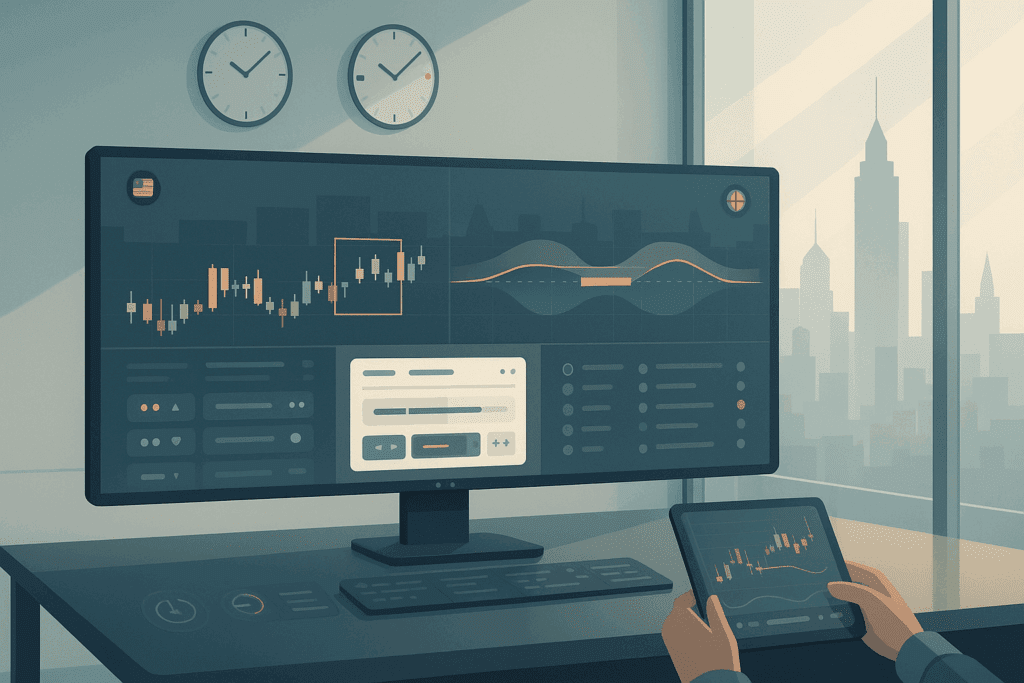
A strong stock indices trading platform should feel like one calm room. You see cash risk before you click, brackets attach by default, and statements match your mental invoice.
If your plan is to trade Nasdaq and FTSE while running index trading with leverage, the real edge is structure. Keep the rules short, the math in cash, and the platform predictable.
The idea in one minute
Indices are rhythmic. Nasdaq tends to move on growth and rate tone. FTSE leans on sector tilt and currency flows. You do not need ten extra indicators. You need two repeatable windows, a fixed cash risk per trade, and a ticket that does the arithmetic for you. When platform and paper tell the same story, trust grows.
“If you can explain the risk in one sentence, the trade is ready.”
Lanes, windows, and what drives them
Choose windows you can repeat. Consistency lives there.
| Index lane | Typical windows* | Main drivers | Personality |
| Nasdaq (US100) | First and last cash hour | Growth vs rates, mega cap earnings | Fast bursts, clean trend days |
| FTSE (UK100) | London morning to midday | Energy, staples, GBP tone | Smoother steps, mean reversion pockets |
| S&P 500 (US500) | First 45 minutes, late day | Breadth and flows | Box break, retest, momentum runs |
| DAX (GER40) | Frankfurt and early London | Euro data and German heavyweights | Firm moves with tidy pullbacks |
*Pick slices you can actually trade, not the entire day.
Ticket math in plain cash
Let the platform do arithmetic. You set a fixed dollar risk per trade and let size follow.
US100 CFD example
- Risk unit: 40 dollars
- Planned stop: 2.0 index points
- Point value example: 1 point equals 1 dollar per contract
- Risk per contract: 2 dollars
- Position size: 40 ÷ 2 equals 20 contracts
UK100 CFD example
- Risk unit: 45 dollars
- Planned stop: 10.0 index points
- Point value example: 1 point equals 0.5 dollars per contract
- Risk per contract: 5 dollars
- Position size: 45 ÷ 5 equals 9 contracts
“You cannot control the market. You can always control position size.”
Three setups that travel across indices
Short definitions hold up when price speeds up.
Range break and retest
Box the first minutes. After a decisive close outside the box, enter on the clean retest with brackets attached. This travels well on Nasdaq, FTSE, and the S&P 500.
Pullback into value
Confirm direction on a higher timeframe, mark a value zone or VWAP band, then trade the first pullback that pauses. Excellent for continuation moves mid session.
Quiet session fade
When pace slows, fade stretched moves back toward value with small size and firm stops. Tight targets protect quiet days.
“If the entry needs a paragraph to justify it, it is not ready.”
Index trading with leverage, handled safely
Leverage is a tool, not a target. Treat it like a seatbelt you tighten on purpose.
| Margin idea | Plain meaning | Your move |
| Initial margin | Cash required to open the position | Confirm headroom before submit |
| Maintenance margin | Minimum to keep the position open | Keep a buffer for routine swings |
| Leverage | Contract value divided by required margin | Use the least leverage that expresses your idea |
| Variation PnL | Mark to market pushes cash around | Expect swings on news days, size down as needed |
Simple rule: fix a cash risk per trade and let size float. That keeps leverage honest.
Costs that decide more than you think
Treat costs like ingredients. Measure them for twenty sessions and better habits will follow.
| Cost line | Where it bites | Practical move |
| Spread plus commission | Every fill | Trade liquid minutes and avoid chasing breaks |
| Slippage | Opens and data minutes | Prefer retests, use limits when speed tempts you |
| Overnight funding | Holds on CFDs | Shorten duration or switch wrapper for carries |
| Data and tools | Extras you barely touch | Keep only what changes outcomes |
“Cost clarity turns uncertainty into a trade you can choose.”
Features that make many indices feel like one room
A dependable stock indices trading platform is predictable rather than flashy.
- Cash risk preview on every order ticket
- Brackets and OCO by default so exits are automatic
- Symbol specs in cash for point value, hours, and funding rules
- Delay and slippage widgets by index and session
- Exportable logs and, ideally, an API to rebuild statements
- Status page with incident timestamps and planned reverts
When these feel normal, your platform fades and your process shines.
A clean routine to trade Nasdaq and FTSE
Before your window
- Mark yesterday’s high and low plus overnight extremes
- Note two catalysts in your local time
- Write your cash risk per trade on a sticky note
During
- Two attempts per idea, then stand down
- Place brackets with the entry
- Screenshot before and after, write one line reason in and one line reason out
After
- Tag by setup and session
- Log spread, commission, and any slippage
- Close the platform on time
Consistency beats intensity.
Two focused mixes for your first month
Nasdaq first, FTSE confirmation
- Windows: first 45 minutes of US cash for Nasdaq, London morning for FTSE
- Risk: 40 dollars per US100 trade, 45 dollars per UK100 trade
- Plan: box break to retest on Nasdaq, pullback into value on FTSE
- Why it works: distinct rhythms, one ticket logic
FTSE anchor with a Nasdaq add
- Windows: London morning for FTSE, short US overlap for Nasdaq
- Risk: 35 to 45 dollars per trade
- Plan: quiet fade on FTSE when pace drops, range break and retest on Nasdaq if the board lines up
- Why it works: avoids doubling exposure while rules stay identical
Guardrails that protect the month
Short rules invite consistent enforcement.
- Per day loss cap that pauses trading
- Max contracts or notional per index and per ticket
- Two attempts per idea, then stand down
- Session filters that keep you out of thin hours
- Clear on screen messages for margin and caps
A day you will recognize
Picture a Tuesday. The bell rings and US100 breaks its box. You let it retest, size by cash, and the bracket attaches. Twenty minutes later UK100 offers a tidy pullback into value on your second window. Same ticket, same math, smaller size. That evening your statement lists spread, commission, and any funding exactly as expected. No creative labels. No guesswork. That is a stock indices trading platform doing the job you hired it to do.
FAQ
Is index trading with leverage safe for small accounts
Yes when you fix a dollar risk per trade, use brackets, and keep a per day loss cap. Leverage expresses size. It should not inflate it.
Can I trade Nasdaq and FTSE from one login
Yes if your platform shows cash risk on the ticket, supports bracket orders by default, and exports logs that match statements exactly.
Do I need depth of market for these setups
Only if your method relies on it. Many index routines work with clean charts, value zones, and bracket orders.
How do I avoid oversizing during hot sessions
Let size float from your fixed cash risk and reduce risk when spreads widen. Prefer retests over chases during data minutes.
Will overnight funding ruin swing trades
It can if you ignore it. Track funding lines for a month. If carries do not pay their keep, shorten duration or use a different wrapper.
What is the single most helpful feature on day one
Cash risk visible on the order ticket. When dollars are clear, every other decision gets easier.
Community
Trading platforms
Services
Articles
Community
Trading platforms
Services




Copyright © 2026. All rights reserved.
There is a risk of loss in trading foreign currencies and it is not suitable for everyone. Tradeview is not responsible for any gains or losses on currency rates or exchanges during any transaction.
The services and products offered by Tradeview are not being offered within the United States (US) and not being offered to US Persons, as defined under US law. The information on this website is not directed to residents of any country where FX and/or CFDs trading is restricted or prohibited by local laws or regulations.
CFDs are complex instruments and come with a high risk of losing money rapidly due to leverage. 64% of retail investors' accounts lose money when trading CFDs with Tradeview. You should consider whether you understand how CFDs work and whether you can afford to take the high risk of losing your money.
Headquarters Tradeview Ltd.: 13 Genesis Close, 4th Floor, Suite 422, Cayman Islands
High Risk Warning: Foreign exchange trading carries a high level of risk that may not be suitable for all investors. Leverage creates additional risk and loss exposure. Before you decide to trade foreign exchange, carefully consider your investment objectives, experience level, and risk tolerance. You could lose some or all your initial investment; do not invest money that you cannot afford to lose. Educate yourself on the risks associated with foreign exchange trading and seek advice from an independent financial or tax advisor if you have any questions.
Advisory Warning: Tradeview provides references and links to selected blogs and other sources of economic and market information as an educational service to its clients and prospects and does not endorse the opinions or recommendations of the blogs or other sources of information. Clients and prospects are advised to carefully consider the opinions and analysis offered in the blogs or other information sources in the context of the client or prospect's individual analysis and decision making. None of the blogs or other sources of information is to be considered as constituting a track record. Past performance is no guarantee of future results and Tradeview specifically advises clients and prospects to carefully review all claims and representations made by advisors, bloggers, money managers and system vendors before investing any funds or opening an account with any Forex dealer. Any news, opinions, research, data, or other information contained within this website is provided as general market commentary and does not constitute investment or trading advice. Tradeview expressly disclaims any liability for any lost principal or profits without limitation which may arise directly or indirectly from the use of or reliance on such information. As with all such advisory services, past results are never a guarantee of future results.