Please note that deposits and withdrawals via Bitwallet are no longer available. Please use alternative methods going forward.
Premarket Trading Explained: How It Works & the Risks

Premarket trading is buying and selling stocks before the regular market opens. In the US, that means trading between roughly 4:00 AM and 9:30 AM ET, ahead of the opening bell. It lets traders react to overnight news early — but it comes with thin liquidity and bigger risks. This guide covers the hours, why traders use it, the dangers, and how to get started.
What is premarket trading?
Premarket trading happens during the “extended hours” session before the regular market opens. Orders are matched through electronic communication networks (ECNs) rather than the main exchange, connecting buyers and sellers directly outside normal hours.
It exists because news doesn’t wait for the opening bell. Earnings reports, economic data, and overnight events move prices while most of the market is asleep — and premarket lets active traders act on them first.
Premarket trading hours
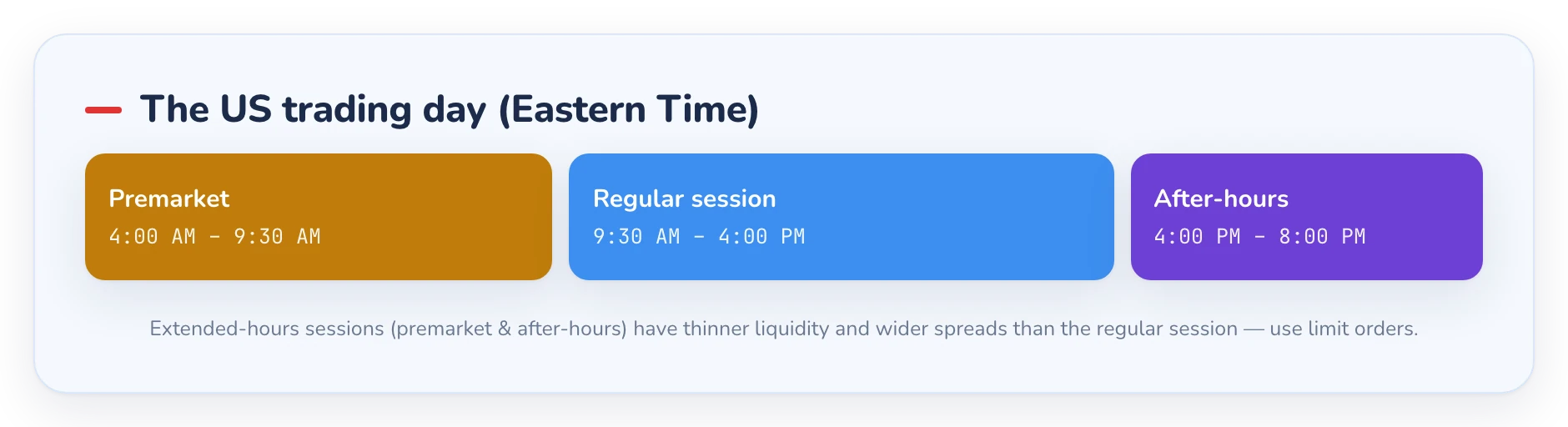
The US trading day splits into three windows (all Eastern Time):
- Premarket: ~4:00 AM – 9:30 AM ET
- Regular session: 9:30 AM – 4:00 PM ET
- After-hours: 4:00 PM – 8:00 PM ET
The most active premarket window is the last hour or two before the open — 8:00 to 9:30 AM ET — when volume builds ahead of the bell. Note that not every broker offers the full premarket window, and exact hours vary.
Why traders use premarket
- React to earnings. Most companies report before the open; premarket lets you trade the reaction immediately.
- Trade overnight news. Economic releases and global events that hit after yesterday’s close get priced in early.
- Gauge the day. Premarket movers and volume hint at where the regular session may head.
- Beat the crowd. Acting before 9:30 can mean a better entry than waiting for the opening rush.
The risks of premarket trading
The early session is riskier than the regular market, and beginners should treat it with caution:
- Low liquidity. Far fewer participants means it’s harder to get filled at a fair price.
- Wide spreads. Thin volume widens the gap between bid and ask, raising your cost to trade.
- Higher volatility. Small orders can swing prices sharply, and moves can reverse hard at the open.
- Limited order types. Many brokers only allow limit orders in premarket — market orders are often blocked to protect you from bad fills.
Be clear-eyed: premarket volatility can work violently against you. Use limit orders, size small, and never assume a premarket move will hold once the bell rings.
How to trade premarket
- Use a broker that supports extended hours. Tradeview Markets offers real US-stock trading on direct-access platforms — Sterling, Takion, and DAS — plus MT5. Extended-hours availability and order-entry rules (windows, permitted order types) vary by platform and account, so check the specifics on the trading platforms page before you trade.
- Always use limit orders. They protect you from the ugly fills that thin liquidity can produce.
- Trade only liquid names. Stocks with real premarket volume (often those with news) are safer than illiquid tickers — the stocks market page lists what’s available to trade.
- Keep size small and your risk per trade tight — the same discipline that governs day trading.
Frequently asked questions
What are premarket trading hours?
In the US, premarket generally runs from about 4:00 AM to 9:30 AM ET, though many brokers offer a shorter window. The busiest stretch is 8:00–9:30 AM, just before the open.
Is premarket trading risky?
Yes — more so than the regular session. Low liquidity, wide spreads, and sharp volatility make it riskier, which is why limit orders and small size are essential.
Can beginners trade premarket?
They can, but it’s advanced. Beginners are usually better off learning during regular hours first, then trying premarket cautiously with limit orders and tiny positions.
Why do stocks move so much in premarket?
Because volume is thin, even small orders can move the price a lot. Overnight news and earnings also concentrate demand into a quiet session, amplifying moves.
Do premarket moves predict the regular session?
Sometimes, but not reliably. Premarket direction can reverse at the open as the full market weighs in, so treat it as a hint, not a guarantee.
Sources
- U.S. Securities and Exchange Commission, Office of Investor Education and Advocacy. After-Hours Trading: Understanding the Risks (lower liquidity, wider spreads, greater volatility). sec.gov
- FINRA (2024). Extended-Hours Trading: Know the Risks — pre-market 7:00–9:30 a.m. ET, after-hours 4:00–8:00 p.m. ET; less liquid, more volatile, no NBBO protection. finra.org
Risk warning. Trading stocks and CFDs carries a high level of risk and may not be suitable for all investors. Extended-hours trading involves additional risks including low liquidity and higher volatility. This article is for educational purposes only and does not constitute financial advice.
Community
Trading platforms
Services
Articles
Community
Trading platforms
Services




Copyright © 2026. All rights reserved.
There is a risk of loss in trading foreign currencies and it is not suitable for everyone. Tradeview is not responsible for any gains or losses on currency rates or exchanges during any transaction.
The services and products offered by Tradeview are not being offered within the United States (US) and not being offered to US Persons, as defined under US law. The information on this website is not directed to residents of any country where FX and/or CFDs trading is restricted or prohibited by local laws or regulations.
CFDs are complex instruments and come with a high risk of losing money rapidly due to leverage. 64% of retail investors' accounts lose money when trading CFDs with Tradeview. You should consider whether you understand how CFDs work and whether you can afford to take the high risk of losing your money.
Headquarters Tradeview Ltd.: 13 Genesis Close, 4th Floor, Suite 422, Cayman Islands
High Risk Warning: Foreign exchange trading carries a high level of risk that may not be suitable for all investors. Leverage creates additional risk and loss exposure. Before you decide to trade foreign exchange, carefully consider your investment objectives, experience level, and risk tolerance. You could lose some or all your initial investment; do not invest money that you cannot afford to lose. Educate yourself on the risks associated with foreign exchange trading and seek advice from an independent financial or tax advisor if you have any questions.
Advisory Warning: Tradeview provides references and links to selected blogs and other sources of economic and market information as an educational service to its clients and prospects and does not endorse the opinions or recommendations of the blogs or other sources of information. Clients and prospects are advised to carefully consider the opinions and analysis offered in the blogs or other information sources in the context of the client or prospect's individual analysis and decision making. None of the blogs or other sources of information is to be considered as constituting a track record. Past performance is no guarantee of future results and Tradeview specifically advises clients and prospects to carefully review all claims and representations made by advisors, bloggers, money managers and system vendors before investing any funds or opening an account with any Forex dealer. Any news, opinions, research, data, or other information contained within this website is provided as general market commentary and does not constitute investment or trading advice. Tradeview expressly disclaims any liability for any lost principal or profits without limitation which may arise directly or indirectly from the use of or reliance on such information. As with all such advisory services, past results are never a guarantee of future results.