Please note that deposits and withdrawals via Bitwallet are no longer available. Please use alternative methods going forward.
7 Reasons Fundamental Analysis of Stocks Beats Guesswork
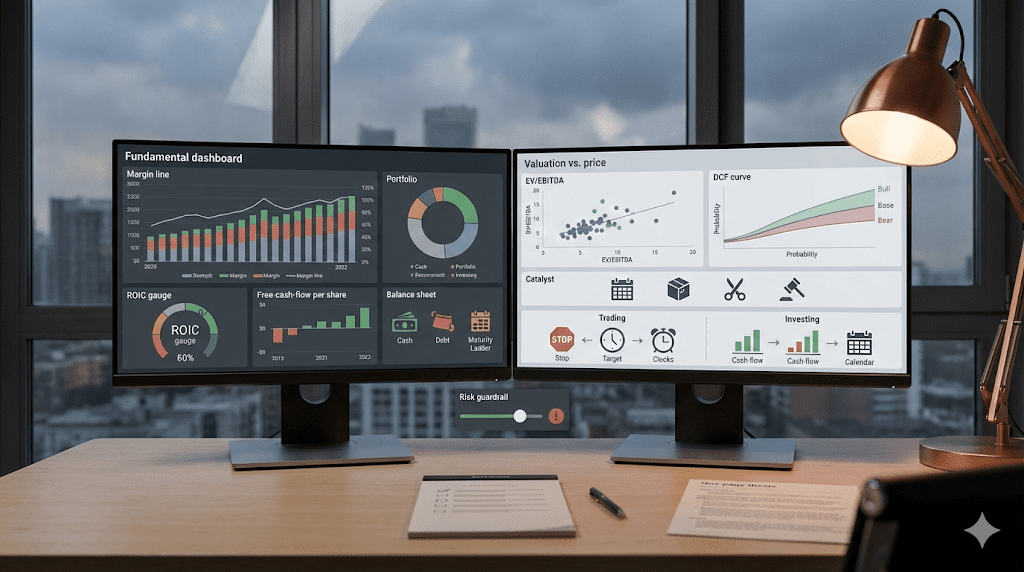
The market opens, prices flicker, and everyone has a take. A clean process keeps you from chasing noise. That is where fundamental analysis of stocks earns its keep.
“Prices wander in the short run, cash flows decide the long run.”
1) You see the business, not just the ticker
Price says what happened, fundamentals hint at why. Revenue lines, margins, and reinvestment rates reveal whether a company can compound or is living off momentum.
Mini checklist: revenue growth trend, operating margin direction, return on invested capital, free cash flow per share.
2) Quality rises when cycles fall
Bear phases punish weak balance sheets. Strong interest coverage, manageable debt, and consistent cash conversion let quality names defend earnings when demand softens.
Simple balance sheet tells: debt maturity ladder that does not bunch in the next 12 to 24 months.
3) Valuation anchors emotions
Multiples give context to headlines. Comparing enterprise value to EBITDA or free cash flow puts hot narratives back on the ground, which reduces FOMO at peaks and panic at troughs.
“Valuation is not timing, it is gravity.”
4) Catalysts turn into probabilities
Earnings, product launches, and regulation shifts are not coin flips when you map them to unit economics. Sketch a base case, bear case, and bull case, then update as facts arrive.
Tiny table: catalyst to numbers
| Catalyst | What to quantify | Decision nudge |
| Pricing change | Gross margin sensitivity | Re-rate or re-wait |
| New product | TAM and margin mix | Stretch or trim targets |
| Cost cuts | Opex run-rate and timing | One-time or durable lift |
5) Better portfolios through mix, not guesswork
Fundamentals help you diversify by business drivers rather than by logo count. Pair cash-cow defensives with selective compounders so your outcomes do not hinge on one theme.
6) Clearer choices in trading stocks vs investing
Short-term trading leans on liquidity and levels. Long-term investing leans on business progress. You can do both, just do not confuse their rules.
| Angle | Trading side | Investing side |
| Holding period | Minutes to weeks | Years |
| Primary input | Price action, catalysts | Cash flows, moats, capital allocation |
| Edge | Execution, timing, risk control | Compounding, valuation discipline |
| Typical exit | Level invalidated, target hit | Thesis broken, valuation stretched |
“Trade the tape when you must, own the business when you can.”
7) Built-in guardrails for size and exits
When fundamentals drive your thesis, risk rules are easier to write and follow. If the margin story breaks or leverage spikes, you cut. If cash generation beats your base case, you add on strength instead of averaging down on hope.
How to use fundamentals in the live session
- Start with one key driver per name, for example unit growth or margin trajectory, so decisions are fast.
- Keep a one-page sheet: thesis in one line, three metrics that would confirm or kill it, and an “if wrong, do this” exit.
Quick model-to-ticket bridge
If base case free cash flow implies 12 percent upside and bear case implies 15 percent downside, size so one loss costs less than one week of gains. That keeps execution honest.
A calm plan for how to manage risk in stock trading
- Fix a cash loss per position before entries.
- Set a portfolio max drawdown that stops new buys until you review.
- Use position tiers: starter, add on confirmation, stop if thesis breaks.
- Log slippage and heat versus stop so you learn which hours treat you kindly.
“Small size plus strict exits beat perfect entries.”
Example table you can copy for any company
| Pillar | Metric to track | Green flag | Red flag |
| Growth | Revenue CAGR and unit growth | Broad-based growth with stable churn | Top-line up, units flat |
| Profitability | Operating margin and cash conversion | Margin expanding with reinvestment | Margin lift only from cuts |
| Balance sheet | Net debt to EBITDA, interest cover | Comfortable runway to refinance | Upcoming maturities stress covenants |
| Capital allocation | Buybacks vs reinvestment | High ROI projects funded first | Buybacks while leverage climbs |
| Valuation | EV FCF or P E vs history | Near median with improving mix | Peak multiple with fading growth |
Pulling it together
If this resonates, pick three holdings and write one page each. One sentence for the thesis, three metrics that matter, the bear case you would respect, and the exact exit level if the bear case shows up. Then let the notebook, not the news, guide size and timing. That routine makes fundamental analysis of stocks the calm center of your plan.
Before the FAQs, one nudge to move today: choose a single name you follow, write the bull, base, and bear in 50 words, and tag the one metric that would make you trim. Do that for a month and your decisions will feel lighter.
FAQ
Does fundamental work for short-term trades
Yes, as a filter. Use fundamentals to pick strong names, then time entries with price and liquidity.
How many metrics should I watch per stock
Three to five. If you need twenty, the thesis is fuzzy.
Can I blend trading and investing
You can. Keep separate accounts or at least separate logs so rules do not clash.
What if valuation looks rich but execution is flawless
Consider a smaller position or wait for better entry bands. Great companies still cycle through fair prices.
Community
Trading platforms
Services
Articles
Community
Trading platforms
Services




Copyright © 2026. All rights reserved.
There is a risk of loss in trading foreign currencies and it is not suitable for everyone. Tradeview is not responsible for any gains or losses on currency rates or exchanges during any transaction.
The services and products offered by Tradeview are not being offered within the United States (US) and not being offered to US Persons, as defined under US law. The information on this website is not directed to residents of any country where FX and/or CFDs trading is restricted or prohibited by local laws or regulations.
CFDs are complex instruments and come with a high risk of losing money rapidly due to leverage. 64% of retail investors' accounts lose money when trading CFDs with Tradeview. You should consider whether you understand how CFDs work and whether you can afford to take the high risk of losing your money.
Headquarters Tradeview Ltd.: 13 Genesis Close, 4th Floor, Suite 422, Cayman Islands
High Risk Warning: Foreign exchange trading carries a high level of risk that may not be suitable for all investors. Leverage creates additional risk and loss exposure. Before you decide to trade foreign exchange, carefully consider your investment objectives, experience level, and risk tolerance. You could lose some or all your initial investment; do not invest money that you cannot afford to lose. Educate yourself on the risks associated with foreign exchange trading and seek advice from an independent financial or tax advisor if you have any questions.
Advisory Warning: Tradeview provides references and links to selected blogs and other sources of economic and market information as an educational service to its clients and prospects and does not endorse the opinions or recommendations of the blogs or other sources of information. Clients and prospects are advised to carefully consider the opinions and analysis offered in the blogs or other information sources in the context of the client or prospect's individual analysis and decision making. None of the blogs or other sources of information is to be considered as constituting a track record. Past performance is no guarantee of future results and Tradeview specifically advises clients and prospects to carefully review all claims and representations made by advisors, bloggers, money managers and system vendors before investing any funds or opening an account with any Forex dealer. Any news, opinions, research, data, or other information contained within this website is provided as general market commentary and does not constitute investment or trading advice. Tradeview expressly disclaims any liability for any lost principal or profits without limitation which may arise directly or indirectly from the use of or reliance on such information. As with all such advisory services, past results are never a guarantee of future results.