What Can Be Traded in a Commodities Market
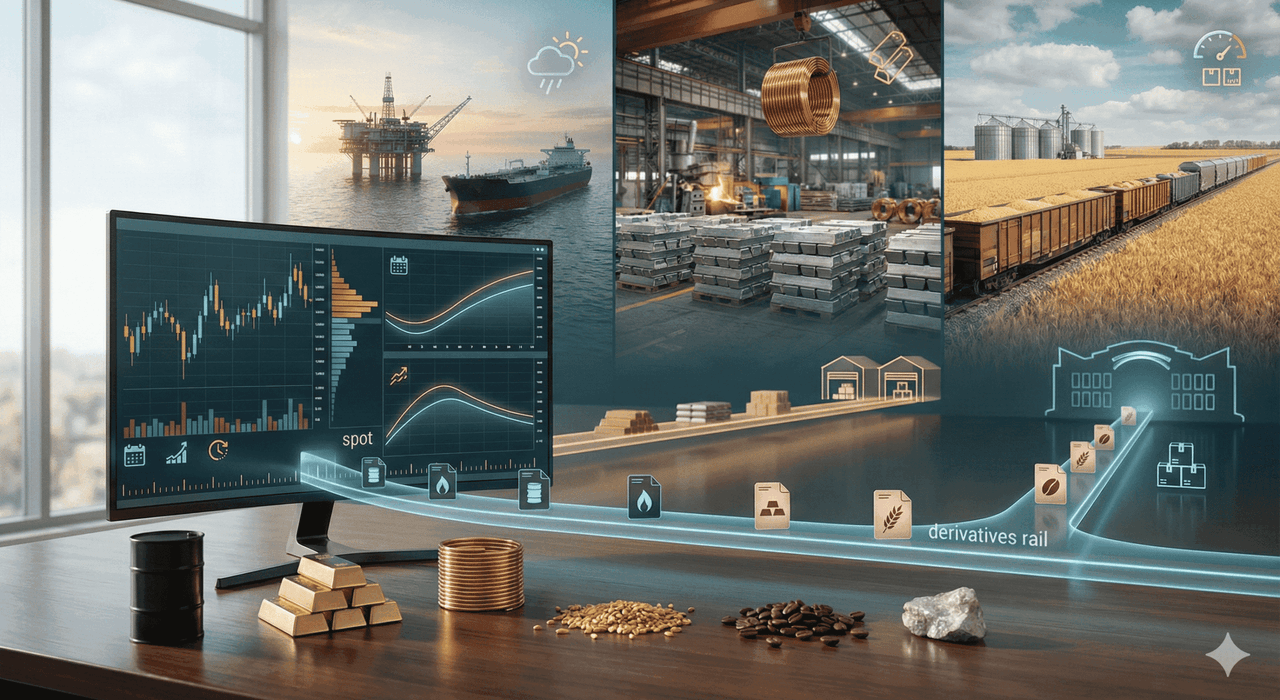
The tickers move, calendars fill up, and it’s easy to forget the simple question: what can be traded in a commodities market? Here’s the calm version with plain-language definitions, concrete examples, and a side-by-side view you can reuse.
“A commodity futures contract is an agreement to buy or sell a particular commodity at a future date; the price and amount are fixed.”
First things first: what is commodity market
A commodity market is where raw or primary goods change hands in spot deals or via derivatives like futures and options. Think energy, metals, and agricultural products.
“The S&P GSCI is one of the most widely recognized commodity benchmarks; broad-based and production-weighted.”
The landscape at a glance: commodity markets by group
A few concrete contract examples
- WTI Crude (NYMEX CL): unit 1,000 barrels; minimum tick 0.01 dollars per barrel equals 10 dollars per tick.
- Brent Crude (ICE B): unit 1,000 barrels; minimum price fluctuation 0.01 dollars per barrel.
- Gold (COMEX GC): contract size 100 troy ounces; tick 0.10 dollars per oz equals 10 dollars per tick.
- Corn (CBOT ZC): contract unit 5,000 bushels; quoted in cents per bushel.
What exactly can you trade (and how)
| Access path | What you actually trade | Why people choose it | Watch-outs |
| Exchange futures | Standardized contracts on energy, metals, gas | Liquidity, central clearing, transparent specs | Margin and daily P/L mean discipline required. |
| Options on futures | Right, not obligation, on a futures contract | Defined risk structures | Greeks and assignment rules add complexity. |
| Spot/forwards (OTC) | Bilateral deals, customized terms | Tailored hedges for commercial users | Counterparty risk and documentation. |
| Index products & ETPs | Baskets tracking commodity indices (e.g., GSCI) | Broad exposure via securities account | Tracking and fees vs underlying futures. |
“Futures contracts are traded on organized exchanges that set standardized terms for the contracts.”
Why conditions change across commodity markets
Global supply, inventories, and policy can reshape price behavior. Recent research highlights how shocks (pandemics, wars, climate) alter energy, metals, and agriculture dynamics for years, not weeks.
Reading the curve without math headaches
Futures may trade above or below spot depending on storage, financing, and inventory (contango vs backwardation). That’s normal. What matters is your carry cost and roll timing, which differ by commodity and season.
Costs and frictions you feel on tickets
- Tick size and tick value (e.g., CL’s $10 per tick; GC’s $10 per tick) drive P/L swings.
- Slippage and spread widen around scheduled reports and thin sessions.
Quick starter map that you can actually use
- Pick one liquid benchmark (WTI, Gold, or Corn).
- Read the exchange spec sheet for size, tick, and hours.
- Put major release times on your calendar (inventories, crop reports).
“Commodity markets are integral to the global economy… understanding what drives these markets is critical.”
FAQ
Is the commodity market only for futures traders
No. Commercials hedge with futures and OTC forwards; investors use index products or producer equities. Futures are just the cleanest price-discovery rail.
Why do WTI and Brent sometimes diverge
Logistics and regional supply differences. Both are 1,000-barrel contracts but different delivery ecosystems and inventories drive spreads.
Do metals markets have different regulations?
Venues implement their own regulations and may modify their positioning or lending policies when stock levels become limited, similar to the actions taken by the LME regarding copper.
Where do I find the exact contract size and tick
Consistently refer to the exchange specifications page for the product, which details units, ticks, trading hours, and relevant codes (such as CL, GC, ZC).
Community
Trading platforms
Services
Articles
Community
Trading platforms
Services




Copyright © 2026. All rights reserved.
There is a risk of loss in trading foreign currencies and it is not suitable for everyone. Tradeview is not responsible for any gains or losses on currency rates or exchanges during any transaction.
The services and products offered by Tradeview are not being offered within the United States (US) and not being offered to US Persons, as defined under US law. The information on this website is not directed to residents of any country where FX and/or CFDs trading is restricted or prohibited by local laws or regulations.
CFDs are complex instruments and come with a high risk of losing money rapidly due to leverage. 64% of retail investors' accounts lose money when trading CFDs with Tradeview. You should consider whether you understand how CFDs work and whether you can afford to take the high risk of losing your money.
Headquarters Tradeview Ltd.: 13 Genesis Close, 4th Floor, Suite 422, Cayman Islands
High Risk Warning: Foreign exchange trading carries a high level of risk that may not be suitable for all investors. Leverage creates additional risk and loss exposure. Before you decide to trade foreign exchange, carefully consider your investment objectives, experience level, and risk tolerance. You could lose some or all your initial investment; do not invest money that you cannot afford to lose. Educate yourself on the risks associated with foreign exchange trading and seek advice from an independent financial or tax advisor if you have any questions.
Advisory Warning: Tradeview provides references and links to selected blogs and other sources of economic and market information as an educational service to its clients and prospects and does not endorse the opinions or recommendations of the blogs or other sources of information. Clients and prospects are advised to carefully consider the opinions and analysis offered in the blogs or other information sources in the context of the client or prospect's individual analysis and decision making. None of the blogs or other sources of information is to be considered as constituting a track record. Past performance is no guarantee of future results and Tradeview specifically advises clients and prospects to carefully review all claims and representations made by advisors, bloggers, money managers and system vendors before investing any funds or opening an account with any Forex dealer. Any news, opinions, research, data, or other information contained within this website is provided as general market commentary and does not constitute investment or trading advice. Tradeview expressly disclaims any liability for any lost principal or profits without limitation which may arise directly or indirectly from the use of or reliance on such information. As with all such advisory services, past results are never a guarantee of future results.