What is Forex Trading and How Does It Work?
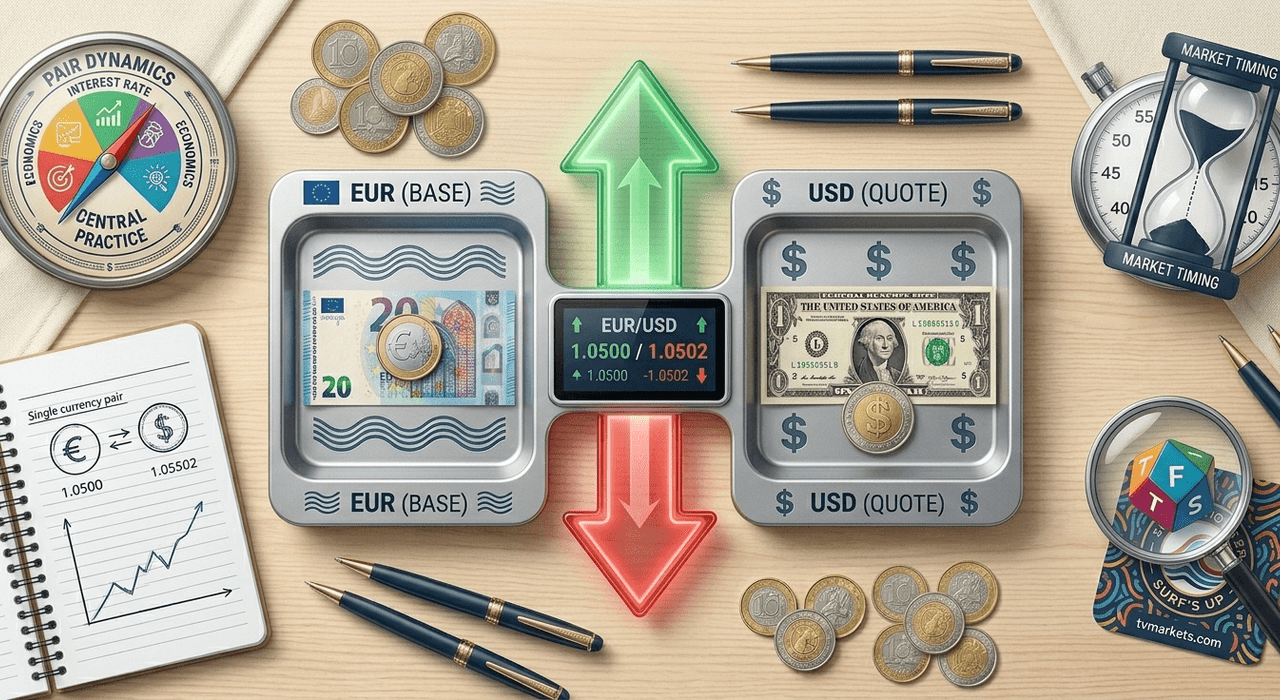
The global financial system is massive, but nothing compares to the sheer scale and speed of the foreign exchange market. With a daily trading volume exceeding $7.5 trillion, it dwarfs the global stock and bond markets combined. It dictates the cost of international imports, drives the profit margins of multinational corporations, and provides a highly liquid arena for retail speculators.
However, if you are new to this ecosystem, the terminology, rapid price movements, and use of leverage act as steep barriers to entry. This guide breaks down exactly what is forex trading and how does it work, providing the structural knowledge required to navigate currency markets like a professional.
Table of Contents
- What is Forex Trading?
- Understanding Currency Trading
- How the Forex Market Works
- The Role of Forex Brokers in Currency Trading
What is Forex Trading?
What is forex trading?
Forex trading is the continuous, simultaneous buying of one currency and selling of another to speculate on the changing exchange rate between them. It is a decentralized global market where financial institutions, corporations, and individual traders exchange national currencies to facilitate international commerce or to generate profit from price fluctuations.
Unlike stocks, forex involves trading currency pairs to speculate on one economy’s strength relative to another. For instance, buying GBP/USD means you expect the British Pound to rise against the US Dollar. You profit if the exchange rate increases and incur a loss if the Pound weakens.
Forex Meaning and Definition
The word “forex” is simply a widely accepted portmanteau of Foreign Exchange. By its strict definition, it encompasses the entire global ecosystem where currencies are converted. This includes everything from commercial banks settling international trade invoices to retail traders executing short-term technical strategies on a digital platform.
What Does FX Mean in Finance?
Within the financial sector, “FX” is the standard shorthand abbreviation for foreign exchange. You will encounter this acronym constantly across institutional research reports, banking departments (e.g., “FX Trading Desk”), and retail broker platforms.
What is the Difference Between Forex and FX?
There is absolutely no difference. “Forex” and “FX” are entirely synonymous terms used interchangeably across the financial industry. A brokerage firm might advertise an “FX trading account” while simultaneously offering a “Forex educational course”—they are referring to the exact same asset class and global market.
Understanding Currency Trading
To succeed in this highly competitive environment, you must grasp the foundational mechanics. You are not buying physical cash to store in a vault; you are executing digital contracts based on live, institutional price feeds.
Defining Forex Trading for Beginners
To understand the core concept, think of a time you traveled internationally. If you flew from the United States to Europe, you exchanged your US Dollars for Euros at an airport kiosk. If you exchanged $1,000 at a rate of 1.00, you received €1,000.
If you held €1,000 while the Euro strengthened from 1.00 to 1.10 against the Dollar, your Euros would be worth $1,100 upon return—a $100 profit. Retail forex trading digitizes and scales this concept, using leverage to allow traders to capitalize on these fluctuations instantly from anywhere in the world.
Common Forex Terms: What is a Pip?
Before placing a live trade, you must speak the market’s language fluently to calculate risk and reward.
- Pip (Percentage in Point): This is the standard unit of measurement for price changes in currency pairs. For most major pairs, it is the fourth decimal place. If the EUR/USD moves from 1.0550 to 1.0551, that represents a one-pip movement. (Exceptions exist, notably Japanese Yen pairs, where the pip is the second decimal place).
- Base and Quote Currency: Currencies are quoted in pairs. In the USD/CAD pair, the USD is the “base currency” (always equal to 1), and the CAD is the “quote currency.” The price on your screen shows exactly how much CAD it takes to buy 1 USD.
- Lot Size: Forex is traded in specific, standardized batches called lots. A “standard lot” represents 100,000 units of the base currency. A “mini lot” is 10,000 units, and a “micro lot” is 1,000 units. The lot size you choose dictates the precise monetary value of a single pip movement.
- Margin and Leverage: Leverage allows you to control a large market position with a relatively small deposit, known as margin. For example, a 50:1 leverage ratio allows you to control a $50,000 position with just $1,000 of margin. While leverage amplifies your potential profits, it equally magnifies your potential losses, making strict risk management mandatory.
How the Forex Market Works
The forex market operates fundamentally differently than centralized stock exchanges like the New York Stock Exchange (NYSE) or the Nasdaq.
The Global Foreign Exchange Market Structure
The foreign exchange market is entirely decentralized, operating Over-the-Counter (OTC). There is no central physical building or singular clearinghouse. Instead, transactions occur electronically directly between counterparties across a massive global network.
Because it lacks a centralized location with opening and closing bells, the market remains open 24 hours a day, five days a week. Trading activity follows the sun, transitioning continuously across four major financial hubs:
- Sydney Session: The global trading week officially opens here on Monday morning (local time).
- Tokyo Session: Handles the bulk of Asian market liquidity.
- London Session: The most dominant and liquid session, processing roughly 43% of all global forex transactions.
- New York Session: The final major session of the day. Maximum market volatility and liquidity typically occur during the crucial hours when the London and New York sessions overlap.
This structure operates as a hierarchy. At the very top is the “interbank market,” consisting of major commercial banks (like JPMorgan, Citi, and UBS) trading massive volumes directly with each other. Below them sit smaller banks, hedge funds, multinational corporations hedging supply chain costs, and finally, retail brokers who provide market access to individual traders.
Types of Forex Trades and Orders
Large institutions trade currencies via the spot, forwards, and futures markets. Retail traders deal almost exclusively in the spot market (or through Contracts for Difference based on spot prices). In the spot market, trades are executed “on the spot” based on current, live market prices.
To navigate the spot market with precision, you must master specific order types:
- Market Order: An order that executes immediately at the best available current price.
- Limit Order: An order placed to execute a trade at a specific price that is more favorable than the current market price (buying below the market, or selling above it).
- Stop Entry Order: An order placed to execute a trade at a specific price that is less favorable than the current market price. Traders primarily use these to catch breakouts when a price breaches a major resistance or support level.
- Stop-Loss Order: The most critical tool in trading. This automated order immediately closes your trade if the price moves against you by a specified amount, capping your maximum loss and protecting your capital.
- Take-Profit Order: Automatically closes your position once it hits a predefined profit target, securing your gains without requiring you to manually watch the screen.
The Role of Forex Brokers in Currency Trading
Individual retail traders cannot directly access the top-tier interbank market; doing so requires tens of millions of dollars in capital and established credit lines. A forex broker serves as the indispensable bridge between you and global liquidity. They aggregate pricing from multiple top-tier banks and deliver it to your retail trading platform.
Brokers typically operate under two primary models: Market Makers (B-Book) and Electronic Communication Networks (ECN / A-Book). Market makers take the opposite side of your trade, while ECN brokers route your order directly into the global liquidity pool to match with an external buyer or seller.
Choosing the right execution model fundamentally impacts your profitability. At Tradeview Markets, our priority is providing institutional-grade infrastructure. “When we analyzed client execution data during the high-volatility Federal Reserve rate hikes in late 2023, we found a stark contrast in performance metrics,” notes a Senior Operations Manager at tvmarkets.com.
“Retail traders utilizing our direct ECN routing experienced 34% less negative slippage and maintained tighter spreads during critical news releases compared to industry averages from standard dealing-desk environments. Connecting traders directly to top-tier liquidity providers doesn’t just improve pricing; it is a critical component of their long-term survival rate.”
How to Trade Forex: A Step-by-Step Guide
Entering the currency market requires an unemotional, highly systematic approach. Consistent profitability stems from executing a rigid process, not from acting on intuition.
- Secure a Regulated Broker: Your capital is only as safe as the regulatory body overseeing your broker. U.S. citizens must ensure their broker is registered with the Commodity Futures Trading Commission (CFTC) and the National Futures Association (NFA). This guarantees transparent pricing, proper capitalization, and the strict segregation of client funds.
- Open a Demo Account: Never fund a live account until you have proven your strategy using virtual money. A demo account provides a risk-free environment to master platform mechanics, test the speed of order execution, and calculate lot sizes without the pressure of losing actual capital.
- Conduct Rigorous Market Analysis: You must have a definitive, data-backed reason for opening a position. Professional traders utilize two primary forms of analysis:
- Fundamental Analysis: Evaluating macroeconomic data, central bank interest rate decisions, inflation reports, and geopolitical events to gauge a currency’s intrinsic strength.
- Technical Analysis: Reading historical price charts, identifying established support and resistance zones, and utilizing mathematical indicators (like Moving Averages or oscillators) to identify high-probability entry and exit points.
- Define Your Risk Parameters: Always calculate your downside before trading. To preserve capital, never risk more than 1% to 2% of your account equity on a single position. For a $5,000 account, this limits risk to $50–$100. Adjust your lot size based on the pip distance to your stop-loss to ensure you stay within these parameters.
- Execute the Trade: Once your technical setup aligns with your risk parameters, input your desired lot size, set your automated Stop-Loss and Take-Profit orders, and execute the market or limit order.
- Monitor and Journal: Once the trade is closed, meticulously log it in a trading journal. Record the entry price, exit price, the emotional state you were in, and screenshots of your chart analysis. Reviewing your past trades—especially your losses—is the most effective method for identifying flaws in your strategy, refining your edge, and evolving into a consistently profitable trader.
Conclusion
Forex trading is a dynamic, global marketplace that offers significant opportunities for those who approach it with the right structural knowledge and discipline. Success in this environment does not come from intuition; it stems from understanding the mechanics of currency pairs, managing risk through strict order types, and utilizing regulated brokers for reliable execution. By treating trading as a systematic business—grounded in analysis, proper risk parameters, and meticulous journaling—you can transition from a beginner to a more informed and capable participant in the world’s largest financial ecosystem.
Frequently Asked Questions
Is forex trading legal?
Yes, forex trading is legal, but it operates under strict regulatory frameworks. In the United States, for example, traders must ensure their broker is registered with the Commodity Futures Trading Commission (CFTC) and the National Futures Association (NFA) to ensure transparent pricing and fund segregation.
What is a forex trader?
A forex trader is an individual or institutional participant who buys and sells currency pairs to speculate on exchange rate fluctuations. Professional traders treat their accounts as a business, focusing on systematic risk management, data-backed analysis, and disciplined execution rather than relying on intuition.
Is forex trading halal?
The provided document does not contain information regarding the religious compliance of forex trading.
Is forex trading good for beginners?
Forex trading presents steep barriers to entry due to complex terminology, rapid price movements, and the risks associated with leverage. It is a high-risk activity that requires disciplined education and rigorous risk management. Beginners are strongly advised to use a demo account to master the mechanics and test strategies before attempting to trade with real capital.
Community
Trading platforms
Services
Articles
Community
Trading platforms
Services




Copyright © 2026. All rights reserved.
There is a risk of loss in trading foreign currencies and it is not suitable for everyone. Tradeview is not responsible for any gains or losses on currency rates or exchanges during any transaction.
The services and products offered by Tradeview are not being offered within the United States (US) and not being offered to US Persons, as defined under US law. The information on this website is not directed to residents of any country where FX and/or CFDs trading is restricted or prohibited by local laws or regulations.
CFDs are complex instruments and come with a high risk of losing money rapidly due to leverage. 64% of retail investors' accounts lose money when trading CFDs with Tradeview. You should consider whether you understand how CFDs work and whether you can afford to take the high risk of losing your money.
Headquarters Tradeview Ltd.: 13 Genesis Close, 4th Floor, Suite 422, Cayman Islands
High Risk Warning: Foreign exchange trading carries a high level of risk that may not be suitable for all investors. Leverage creates additional risk and loss exposure. Before you decide to trade foreign exchange, carefully consider your investment objectives, experience level, and risk tolerance. You could lose some or all your initial investment; do not invest money that you cannot afford to lose. Educate yourself on the risks associated with foreign exchange trading and seek advice from an independent financial or tax advisor if you have any questions.
Advisory Warning: Tradeview provides references and links to selected blogs and other sources of economic and market information as an educational service to its clients and prospects and does not endorse the opinions or recommendations of the blogs or other sources of information. Clients and prospects are advised to carefully consider the opinions and analysis offered in the blogs or other information sources in the context of the client or prospect's individual analysis and decision making. None of the blogs or other sources of information is to be considered as constituting a track record. Past performance is no guarantee of future results and Tradeview specifically advises clients and prospects to carefully review all claims and representations made by advisors, bloggers, money managers and system vendors before investing any funds or opening an account with any Forex dealer. Any news, opinions, research, data, or other information contained within this website is provided as general market commentary and does not constitute investment or trading advice. Tradeview expressly disclaims any liability for any lost principal or profits without limitation which may arise directly or indirectly from the use of or reliance on such information. As with all such advisory services, past results are never a guarantee of future results.