The Essential Guide to Forex Trading Platforms for US Traders
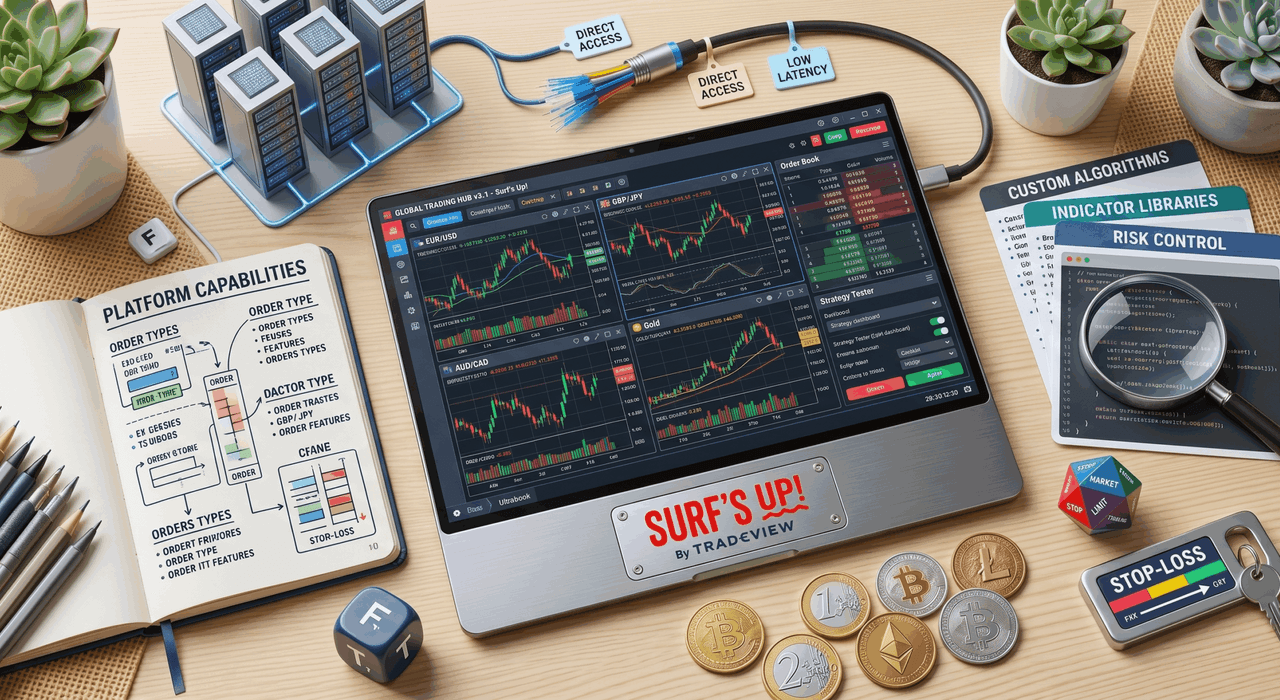
The question of where you trade is often as important as how you trade. To navigate the currency markets successfully, your choice of environment—your forex trading platforms and the broker behind them—must align with your objectives.
Choosing the right technology and provider is the most critical decision a new trader makes. It’s not just about flashy charts; it’s about reliability, regulation, liquidity, and a platform’s ability to help you find an edge.
Table of Contents
Forex Trading Brokers
A forex broker is not just an order execution service. They are your vital connection to global liquidity and your regulatory safety net. For US-based traders, this relationship is unique due to some of the strictest regulations in the world.
To operate legally in the US, brokers must be Retail Foreign Exchange Dealers (RFED) registered with the CFTC and members of the NFA. This registration ensures strict oversight, capital guarantees, and consumer protections not typically available in offshore jurisdictions.
Top Forex Brokers
The definition of “top” varies by trader. Some need deep institutional liquidity and tight spreads, while others require extensive educational resources and simple interfaces. The most successful traders don’t look for the biggest bonus; they look for consistency and reliability.
At Tradeview Markets, our ECN (Electronic Communication Network) model provides direct access to deep liquidity. This approach helps retail traders improve execution quality, particularly during high-volatility news events when other brokerages might see significant spread widening.
Top 10 Forex Brokers in the World
Defining a global “top 10” depends on a trader’s location and regulatory needs. Tier-one firms like Tradeview Markets, IG, Saxo Bank, and Interactive Brokers are recognized for strong regulation, diverse assets, and robust infrastructure, often offering proprietary technology alongside MetaTrader.
Forex Broker Comparison
Comparing brokers goes beyond a checklist. While things like regulation are non-negotiable, you should also look for:
- Trading Costs: This includes spreads (the difference between the buy and sell price) and any commissions. Some brokers offer a “raw spread” account with a per-trade commission, while others offer a wider spread with no commission.
- Asset Variety: How many currency pairs do they offer? Do they also provide access to other markets like CFDs on indices, commodities, or cryptocurrencies?
- Margin & Leverage: US regulations cap leverage at 50:1 for major currency pairs and 20:1 for exotic pairs. Understanding these limits and the broker’s margin call policy is essential.
- Platform Support: Do they offer MetaTrader 4 (MT4), MetaTrader 5 (MT5), cTrader, or their own proprietary platform? Is it available on desktop, web, and mobile?
- Funding & Withdrawals: How easy is it to deposit and, more importantly, withdraw your money? Look for a variety of payment methods and clear timelines.
A successful comparison often involves opening demo accounts with two or three leading candidates to experience their execution speed and platform usability first-hand.
Broker Currency Trading
The practice of currency trading through a broker is what we know as retail forex. It allows individual investors to speculate on the relative value of global currencies with high-speed execution and lower barriers to entry than was historically possible. This democratization of the market is enabled by trading platforms that combine charting, order entry, and analysis into a single, intuitive interface.
Forex Day Trading
Day trading is a fast-paced strategy where positions are opened and closed within the same trading session. To be effective in this, a platform must prioritize speed, real-time data, and advanced technical analysis tools.
For day traders, milliseconds matter. Your platform’s ability to process data, transmit your order to the liquidity provider, and confirm your execution without significant delay is paramount. This infrastructure is often referred to as low-latency trading, and it’s a primary reason why professional day traders prefer brokers with direct ECN or STP (Straight-Through Processing) models.
FX Trading Platform
An FX trading platform acts as your command center, integrating real-time charting, order execution, risk management, and market analysis into a single interface to help you make fast, informed decisions.
- Real-Time Charting: The ability to visualize price action on various timeframes is the foundation of technical analysis. Good platforms offer extensive drawing tools and pre-built indicators.
- Order Execution: Different strategies require different order types (market, limit, stop). Your platform should make order placement fast and minimize the chance of errors.
- Risk Management: Tools to easily set stop-losses and take-profit levels are essential. Some platforms offer advanced features like trailing stops or an easy-to-read margin usage indicator.
- Market News and Analysis: An integrated news feed and economic calendar help you stay on top of the macroeconomic events that drive currency values.
- Backtesting: Advanced platforms allow you to test your automated or manual strategies against historical data to evaluate their potential effectiveness before risking real capital.
Foreign Exchange Trading Platform
A “foreign exchange trading platform” executes trades at interbank prices, which may cause “slippage”—the difference between expected and actual prices. Top-tier brokers engineering their platforms to minimize negative slippage and maximize positive execution opportunities.
Best Trading Platform for Beginners
If you’re new to the market, your primary goal shouldn’t be to find the most powerful platform, but the one with the shallowest learning curve that still offers the essential tools. The “best” platform for a beginner is one that focuses on usability, education, and risk control.
Best Forex Trading Brokers
For beginners in the US, the most critical step is picking a broker that can guide you. Look for providers with:
- A Robust, Standard Platform: Start with a widely used platform like MetaTrader 4 (MT4). Its consistency across different brokers means that skills you learn are transferable, and there is a wealth of community-created help and educational content available.
- Extensive Educational Resources: Look for brokers that offer a structured curriculum, not just a few static articles. Live webinars, tutorial videos, and comprehensive guides are invaluable.
- An Impeccable Regulatory Record: Only consider CFTC-registered, NFA-member brokers. This provides a baseline of trust and consumer protection that is not present with offshore entities.
- Excellent Customer Support: When you have a question or an issue, you need to be able to reach someone quickly and easily. Look for brokers that offer 24/5 phone, email, and live chat support in your language.
The Indispensable Role of a Demo Account
Your most valuable educational tool is a free demo account. This is a practice environment that simulates a real trading account with a virtual balance.
Question & Answer
What is forex trading?
Forex trading is the global decentralized market for buying and selling currencies. As the world’s largest financial market, it sees over $7.5 trillion in daily volume, involving central banks, corporations, institutions, and retail traders.
Conclusion
Ultimately, success in forex trading relies on selecting a regulated, reliable broker and utilizing the right platform tools. By combining disciplined risk management with continuous education, you can confidently navigate the currency markets and build a sustainable trading strategy.
Community
Trading platforms
Services
Articles
Community
Trading platforms
Services




Copyright © 2026. All rights reserved.
There is a risk of loss in trading foreign currencies and it is not suitable for everyone. Tradeview is not responsible for any gains or losses on currency rates or exchanges during any transaction.
The services and products offered by Tradeview are not being offered within the United States (US) and not being offered to US Persons, as defined under US law. The information on this website is not directed to residents of any country where FX and/or CFDs trading is restricted or prohibited by local laws or regulations.
CFDs are complex instruments and come with a high risk of losing money rapidly due to leverage. 64% of retail investors' accounts lose money when trading CFDs with Tradeview. You should consider whether you understand how CFDs work and whether you can afford to take the high risk of losing your money.
Headquarters Tradeview Ltd.: 13 Genesis Close, 4th Floor, Suite 422, Cayman Islands
High Risk Warning: Foreign exchange trading carries a high level of risk that may not be suitable for all investors. Leverage creates additional risk and loss exposure. Before you decide to trade foreign exchange, carefully consider your investment objectives, experience level, and risk tolerance. You could lose some or all your initial investment; do not invest money that you cannot afford to lose. Educate yourself on the risks associated with foreign exchange trading and seek advice from an independent financial or tax advisor if you have any questions.
Advisory Warning: Tradeview provides references and links to selected blogs and other sources of economic and market information as an educational service to its clients and prospects and does not endorse the opinions or recommendations of the blogs or other sources of information. Clients and prospects are advised to carefully consider the opinions and analysis offered in the blogs or other information sources in the context of the client or prospect's individual analysis and decision making. None of the blogs or other sources of information is to be considered as constituting a track record. Past performance is no guarantee of future results and Tradeview specifically advises clients and prospects to carefully review all claims and representations made by advisors, bloggers, money managers and system vendors before investing any funds or opening an account with any Forex dealer. Any news, opinions, research, data, or other information contained within this website is provided as general market commentary and does not constitute investment or trading advice. Tradeview expressly disclaims any liability for any lost principal or profits without limitation which may arise directly or indirectly from the use of or reliance on such information. As with all such advisory services, past results are never a guarantee of future results.