Please note that deposits and withdrawals via Bitwallet are no longer available. Please use alternative methods going forward.
Multiple Asset Account Trading That Stays Organized
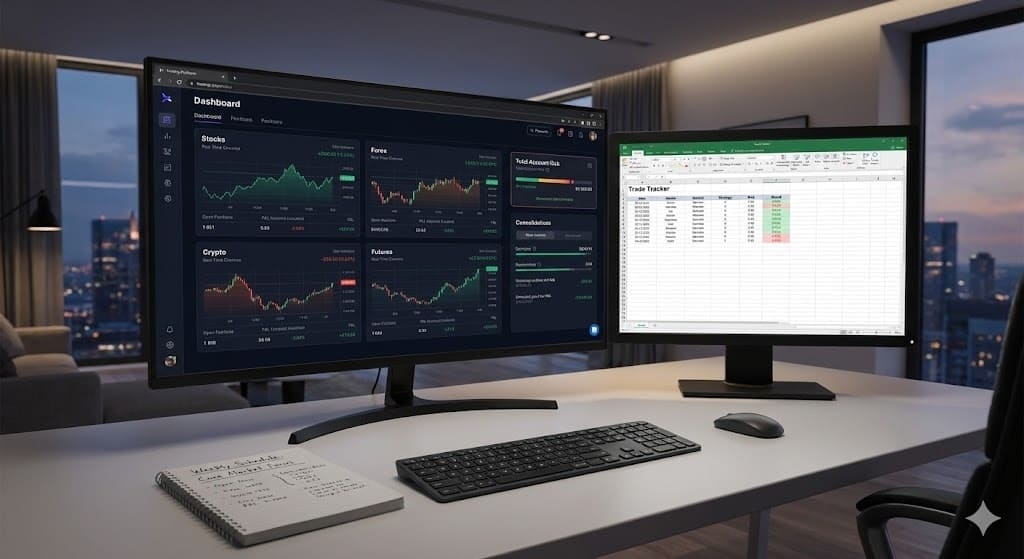
You start with one market because it feels manageable. Maybe it’s forex, maybe it’s stocks. Then life happens: you see a clean opportunity in an index, you want to hedge a currency move, or you simply get tired of juggling three apps that all show “P&L” in slightly different ways.
That’s where multiple asset account trading becomes appealing. One login, one cash pool, one place to see risk. Sounds simple. The catch is that simplicity at the surface can hide complexity underneath, especially once leverage, different market hours, and correlated positions enter the chat.
“The mess isn’t the number of markets. It’s the number of rules you’re trying to remember.” (Trading journal)
The goal of this guide is to help you use multiple asset account trading without turning your week into a whiplash of different strategies. We’ll keep it practical: what to set up, what to track, and how to trade multiple markets online with a routine you can actually follow.
The appeal of multiple asset account trading
Multiple asset account trading means using one brokerage account (or one unified account view) to access more than one asset class, for example stocks, ETFs, options, futures, forex, commodities, or crypto. Instead of treating each market like a separate universe, you manage them under a single risk umbrella.
Why traders and investors like it
- One risk picture: your exposure is visible across positions, not scattered across platforms.
- Cash efficiency: idle cash in one sleeve can cover margin needs in another, depending on broker rules.
- Fewer operational mistakes: fewer logins, fewer transfers, fewer “wrong account” moments.
- Easier hedging: you can pair positions across markets, like holding stocks while offsetting with currency or index exposure.
This matters for online market trading, because speed and clarity beat fancy features. If you can see your total exposure quickly, you make fewer panicked decisions.
The hidden complexity people underestimate
Going multi-asset doesn’t only add opportunity. It adds interaction effects.
Correlation is the quiet risk
Two trades in different markets can still be the same bet. A long USD position in forex and a long US equities position can move together on risk-on or risk-off days. It looks diversified until it isn’t.
“Diversified positions can still be one opinion wearing different outfits.” (Risk note)
Leverage works differently across products
A stock position, a futures contract, and a forex trade each come with their own margin logic. When you trade multiple markets online, you’re also juggling different liquidation rules. One bad move in a leveraged product can pressure the whole account.
Market hours and gaps are not the same
- Stocks have a regular session and different liquidity pre and after hours.
- Futures can trade nearly around the clock, but liquidity shifts by session.
- Forex is continuous during the week, then gaps over the weekend.
- Crypto trades 24/7, which changes risk for anyone who sleeps.
A multi-asset routine must respect these clocks, or you’ll end up managing positions at the worst times.
Design your account like a system, not a buffet
Multiple asset account trading works best when you choose a small “home base” and treat everything else as optional.
Pick your core and your satellites
Start by naming your core market. This is where you’ll spend most of your attention and where your main strategy lives.
- Core market examples: major FX pairs, US large-cap stocks, index futures, or a single crypto pair.
- Satellite markets: the places you go for specific roles, like hedging, long-term investing, or event-driven trades.
A simple rule: if a market doesn’t have a job, it’s a distraction.
Define the job of each market
Common “jobs” that keep your mix sane:
- Income or growth: stocks and ETFs for longer holds.
- Tactical trading: forex or futures for short-term moves.
- Hedge layer: index exposure to reduce portfolio swings.
- Diversifier: commodity exposure if it truly behaves differently in your environment.
Put it in writing. It’s harder to overtrade a market when you’ve assigned it a role.
Build one weekly schedule that matches market hours
A workable schedule is more valuable than a perfect strategy. Here’s a template you can adapt:
- Weekend or Monday prep: big picture, key events, levels, watchlist.
- Two to three execution windows: short blocks where you place trades.
- Daily close review: 10 minutes to tag trades and note mistakes.
If you’re doing online market trading with a job or family, time blocks are the difference between planned trades and revenge trades.
Platform basics that make multi-asset life easier
Your platform doesn’t need to be flashy. It needs to be consistent across asset types and honest about risk.
A clean multi-asset platform checklist
- Unified account view (positions plus cash in one dashboard)
- Clear margin reporting (initial margin, maintenance margin, real-time equity)
- Reliable statements and exports (CSV or API access)
- Order types you understand (limit, stop, stop-limit, bracket orders if available)
- Alerts (price, margin, and key events)
When you trade multiple markets online, reporting and order entry become safety tools, not admin chores.
Order gotchas by asset class
Different markets have different defaults. That’s where mistakes happen.
| Market | Common order surprise | Better habit |
| Stocks | Thin liquidity outside regular hours | Use limit orders, size down off-hours |
| Options | Wide spreads and IV shifts | Avoid market orders, know the basics |
| Futures | Leverage is high and tick values vary | Calculate $ risk per tick before entry |
| Forex | Stops can slip on news and weekends | Reduce size near releases, avoid blind holds |
| Crypto | 24/7 swings and weekend volatility | Use alerts, avoid oversized positions overnight |
This table looks simple, but it prevents the “same button, different consequences” problem.
Risk rules that survive multiple markets
If you only take one thing from this guide, make it this: one account means one risk budget.
Set a top-level risk budget
Pick a maximum account drawdown you’re willing to tolerate in a week or month. Then reverse-engineer daily and per-trade limits from it.
Example framework (adjust to your comfort):
- Max daily loss: 1% to 2% of equity
- Max weekly loss: 3% to 5%
- Risk per trade: 0.25% to 1% (based on frequency and product)
“You don’t control outcomes. You control how much of you is on the line.” (Coach note)
Allocate risk by market role
Multiple asset account trading often fails because one product silently dominates risk. Fix that with caps.
- Core market risk cap: for example 60% of active risk budget
- Satellites cap: for example 40% combined
- Any single trade cap: for example 25% of the daily loss limit
The point isn’t perfection. The point is preventing one fast market from wiping out progress made elsewhere.
A quick leverage sanity check
Before you place a trade, answer:
- If I’m wrong immediately, how much do I lose in dollars?
- If liquidity gets weird, could the loss be materially bigger?
If the second answer is “yes,” size down. This is especially relevant for online market trading around news, open and close transitions, and weekends.
Worked example: translating stops into dollars
Say you have a $10,000 account.
- Risk per trade: 0.5% (=$50)
- Your stop is 20 units away
Your position size should be set so that 20 units is about a $50 loss. If your platform can’t show that clearly, compute it before you trade. It feels slow once, then it becomes automatic.
Tracking across markets without drowning in spreadsheets
Multi-asset trading becomes chaotic when you can’t answer simple questions like “Which strategy is working?” or “Which market is causing my drawdowns?”
Tag everything
Instead of tracking only by instrument, track by strategy and intent.
Useful tags:
- Strategy: trend pullback, breakout retest, mean reversion, carry
- Horizon: scalp, day trade, swing, position
- Market role: core, hedge, satellite
- Session: Asia, London, NY, regular hours
A simple tracking table
| Field | Example | Why it matters |
| Date/time | 2026-01-08 09:45 | Session behavior affects outcomes |
| Market | FX, Stocks, Futures | Different risk mechanics |
| Instrument | EURUSD, SPY, ES | Specific exposure |
| Strategy tag | Breakout retest | Compare apples to apples |
| Risk in $ | 50 | Discipline stays visible |
| Result in R | +1.2R | Normalizes across products |
| Notes | Late entry, clean stop | Builds feedback |
Track consistently and you’ll spot patterns faster than any indicator can.
Community trading strategies for a multi-asset routine
Even if you trade solo, you’re still influenced by the internet. The trick is using community ideas without letting them drive your risk.
Use community for context, not commands
Healthy:
- Borrow watchlists and levels
- Compare scenarios
- Ask for feedback on rule-following
Unhealthy:
- Copy entries without understanding stop logic
- Increase size because “everyone agrees”
- Chase the most talked-about market of the day
“Borrow the lens, not the trigger finger.” (Peer note)
Common mistakes in multiple asset account trading
- Adding markets to fix boredom instead of fixing a shaky process
- Confusing diversification with safety when positions are correlated or leveraged
- Letting one product set the emotional tone (often the most leveraged one)
- Ignoring costs and financing like spreads, fees, swaps, funding rates
- No plan across time zones, which turns holding into hope
A practical 30-day ramp plan
Week 1: build the foundation
- Choose your core market and one satellite market only
- Write the “job” for each
- Set your risk budget and daily loss limit
- Build your tracking sheet with tags
Week 2: trade small, review daily
- Take fewer trades than you think you need
- Focus on sizing and clean stops
- Track results in R, not only dollars
Week 3: add one controlled expansion
- Add one more instrument (not a whole new asset class)
- Keep the same strategy framework
- Watch correlation and overlapping exposure
Week 4: stress test your routine
- Simulate a volatile day (reduced size, fewer trades, tighter rules)
- Review your biggest mistake category
- Adjust one rule, not ten
Follow this and you’ll be able to trade multiple markets online with a system that can handle both quiet days and noisy days.
If you want a fast way to make this real, write your one-page market map (core, satellites, jobs, risk caps) and your weekly schedule, then keep it visible next to your platform for two weeks. If you share your core market, the two other markets you’re tempted to add, and the hours you can trade, I can help you turn that into a tighter routine for online market trading before you scale up.
FAQ
Is multiple asset account trading better than using separate accounts?
It can be, mainly for visibility and simpler cash management. Separate accounts can help create hard walls between strategies, but they also add friction and can hide total exposure.
How many markets should I trade at the same time?
Start with one core market and one satellite. Add only after you can follow your risk rules for at least 20 trading sessions.
Does trading multiple markets online reduce risk automatically?
No. It can reduce risk if exposures truly diversify and position sizes respect a shared budget. If markets are correlated or leveraged, risk can increase.
Which order type is safest across most markets?
Limit orders are often safer for entries because they reduce surprise fills. Stops are useful for exits, but plan for slippage in fast conditions.
What should I track first if I feel overwhelmed?
Track risk per trade in dollars, result in R, and one short note about rule-following. Add more fields later only after you’re consistent.
Can online market trading work with a busy schedule?
Yes, if you define execution windows and avoid constant monitoring. Two or three focused blocks per week can beat all-day scrolling.
Community
Trading platforms
Services
Articles
Community
Trading platforms
Services




Copyright © 2026. All rights reserved.
There is a risk of loss in trading foreign currencies and it is not suitable for everyone. Tradeview is not responsible for any gains or losses on currency rates or exchanges during any transaction.
The services and products offered by Tradeview are not being offered within the United States (US) and not being offered to US Persons, as defined under US law. The information on this website is not directed to residents of any country where FX and/or CFDs trading is restricted or prohibited by local laws or regulations.
CFDs are complex instruments and come with a high risk of losing money rapidly due to leverage. 64% of retail investors' accounts lose money when trading CFDs with Tradeview. You should consider whether you understand how CFDs work and whether you can afford to take the high risk of losing your money.
Headquarters Tradeview Ltd.: 13 Genesis Close, 4th Floor, Suite 422, Cayman Islands
High Risk Warning: Foreign exchange trading carries a high level of risk that may not be suitable for all investors. Leverage creates additional risk and loss exposure. Before you decide to trade foreign exchange, carefully consider your investment objectives, experience level, and risk tolerance. You could lose some or all your initial investment; do not invest money that you cannot afford to lose. Educate yourself on the risks associated with foreign exchange trading and seek advice from an independent financial or tax advisor if you have any questions.
Advisory Warning: Tradeview provides references and links to selected blogs and other sources of economic and market information as an educational service to its clients and prospects and does not endorse the opinions or recommendations of the blogs or other sources of information. Clients and prospects are advised to carefully consider the opinions and analysis offered in the blogs or other information sources in the context of the client or prospect's individual analysis and decision making. None of the blogs or other sources of information is to be considered as constituting a track record. Past performance is no guarantee of future results and Tradeview specifically advises clients and prospects to carefully review all claims and representations made by advisors, bloggers, money managers and system vendors before investing any funds or opening an account with any Forex dealer. Any news, opinions, research, data, or other information contained within this website is provided as general market commentary and does not constitute investment or trading advice. Tradeview expressly disclaims any liability for any lost principal or profits without limitation which may arise directly or indirectly from the use of or reliance on such information. As with all such advisory services, past results are never a guarantee of future results.